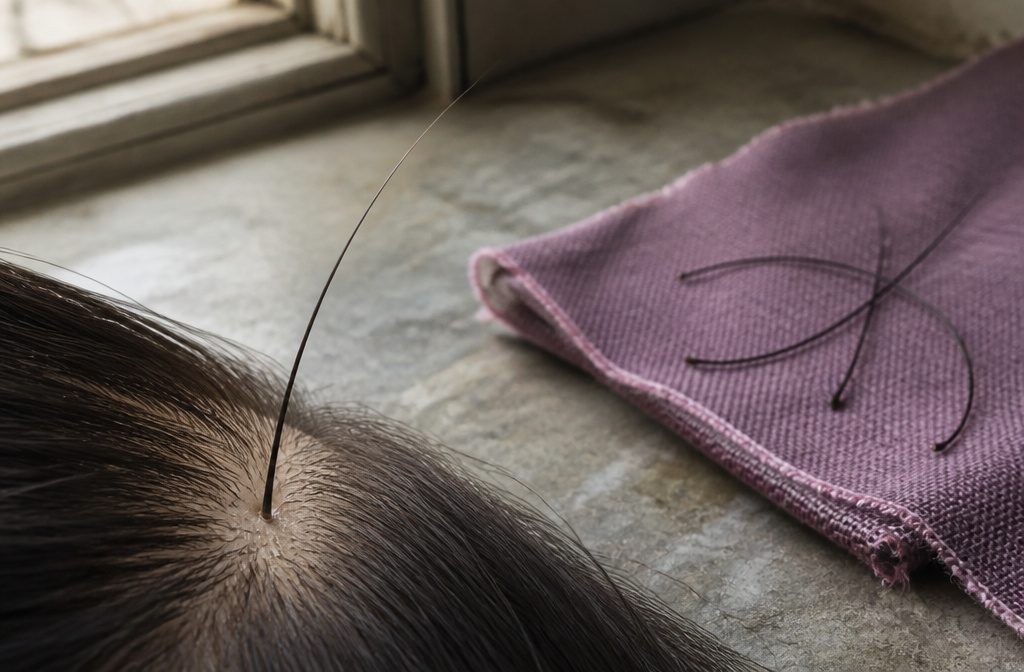
The hair growth cycle is the repeating sequence of growth, transition, rest and shedding that every follicle passes through independently, over and over, for as long as the follicle remains alive.
Each follicle runs on its own clock, which is the only reason you can lose 50 to 100 hairs a day without your scalp looking thinner.
The anagen growth phase lasts 2 to 7 years on the scalp, accounting for roughly 85 to 90% of your hair at any moment.
Anagen Phase
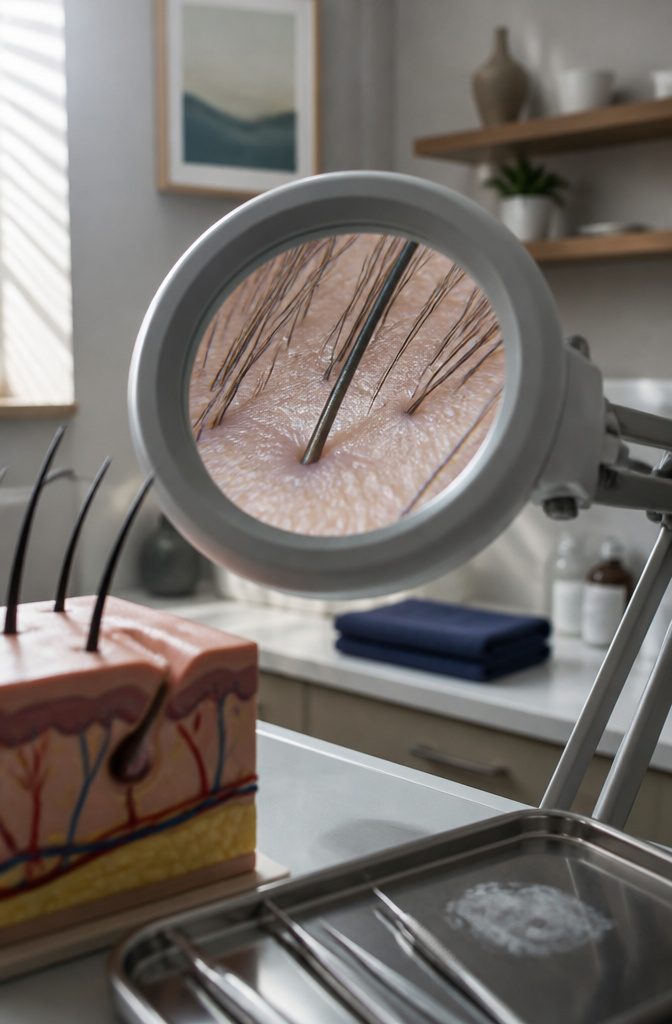
Anagen is the active growth phase, when the follicle pushes out hair and cells in the bulb divide roughly every 23–72 hours. That rapid pace makes follicle cells some of the fastest-dividing in the body.
The dermal papilla at the base pulls in nutrients and oxygen through blood supply, matrix cells multiply to form the hair shaft and its protective sheaths, and melanocytes inject pigment into the growing strand.
Anagen lasts 2–7 years on the scalp and accounts for about 85–90% of your hair at any moment. Genetics sets how long a follicle holds in this phase, which is why some people hit waist length and others plateau at shoulder.
Eyebrow follicles stay in anagen for only two to three months, which keeps brows short no matter how long you leave them. Scalp hair grows about 1 centimeter per month during anagen, or roughly 15 centimeters per year.
Conditions like androgenetic alopecia work by shortening anagen. A follicle that once sustained five years of growth may shrink to a few months, producing only fine, sparse hairs before cycling out.
Catagen Phase
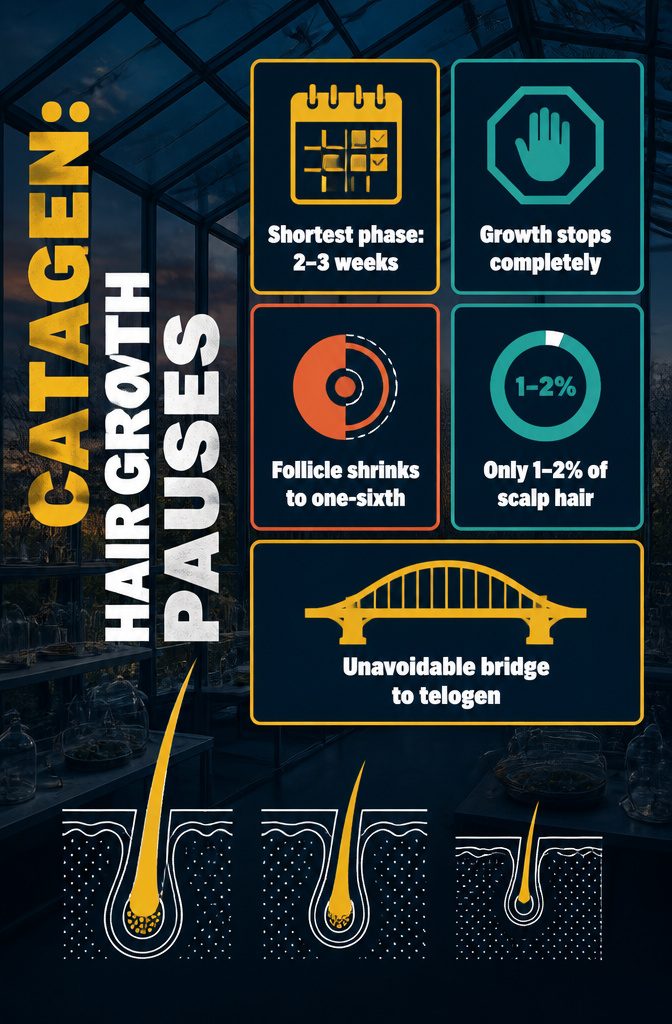
Catagen arrives the moment anagen ends and lasts just two to three weeks, making it the shortest stretch of the cycle.
Growth stops completely, the follicle shrinks to roughly a sixth of its active length, and the hair detaches from the blood supply at the dermal papilla.
What remains is a club hair: no longer growing, anchored only by the outer root sheath, waiting out the final phases before it sheds.
Only about 1–2% of scalp hair sits in catagen at any moment, which is why you never notice it happening. The follicle has already signaled shutdown, melanin production ceases, and the structure prepares to rest.
Catagen cannot be skipped. Every follicle passes through it on the way from active growth to the resting phase, bridging anagen and telogen in a brief, unavoidable transition.
Telogen Phase
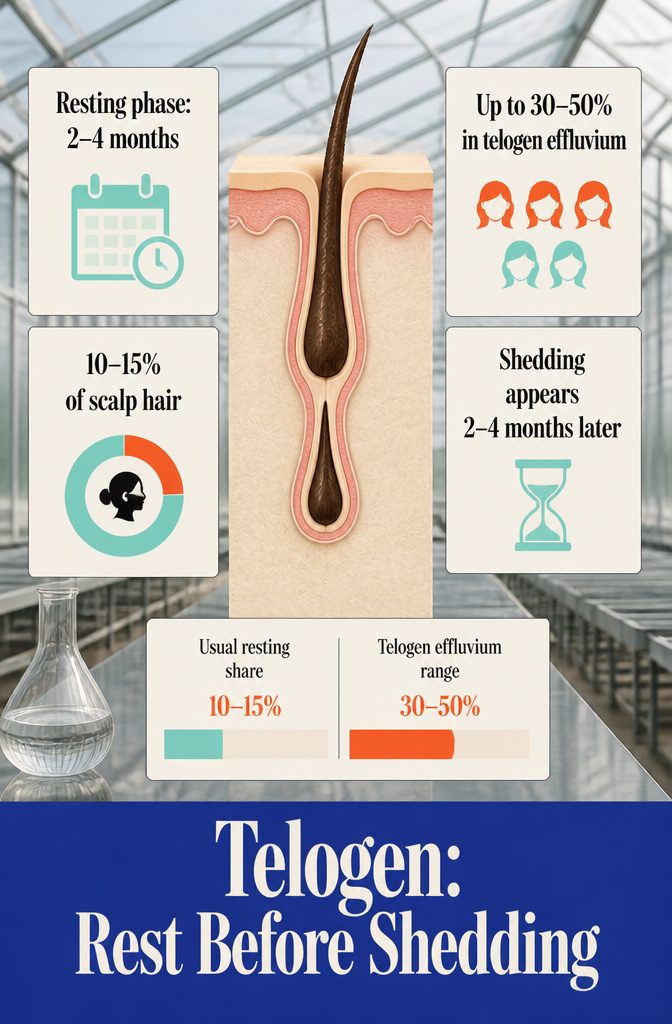
Telogen is the resting phase. The follicle goes dormant for roughly 2–4 months, and the club hair sits anchored without growing.
No nutrients reach the shaft. At any given moment, about 10–15% of the hair on your scalp is parked in telogen, which is why you’re not shedding everything at once.
Beneath the surface, a new hair may already be forming in follicles that recently released a strand during catagen. The old club hair waits, still rooted, until the new anagen hair beneath it pushes it out.
When too many follicles shift into telogen simultaneously, the result is telogen effluvium.
Stress, illness, surgery or nutritional deficiency can trigger it. Instead of the usual 10–15%, up to 30–50% of hairs enter the resting phase at once.
Because telogen lasts months, the shedding shows up 2–4 months after whatever caused it, often catching people off guard when the timing doesn’t line up with their daily routine.
Exogen Phase
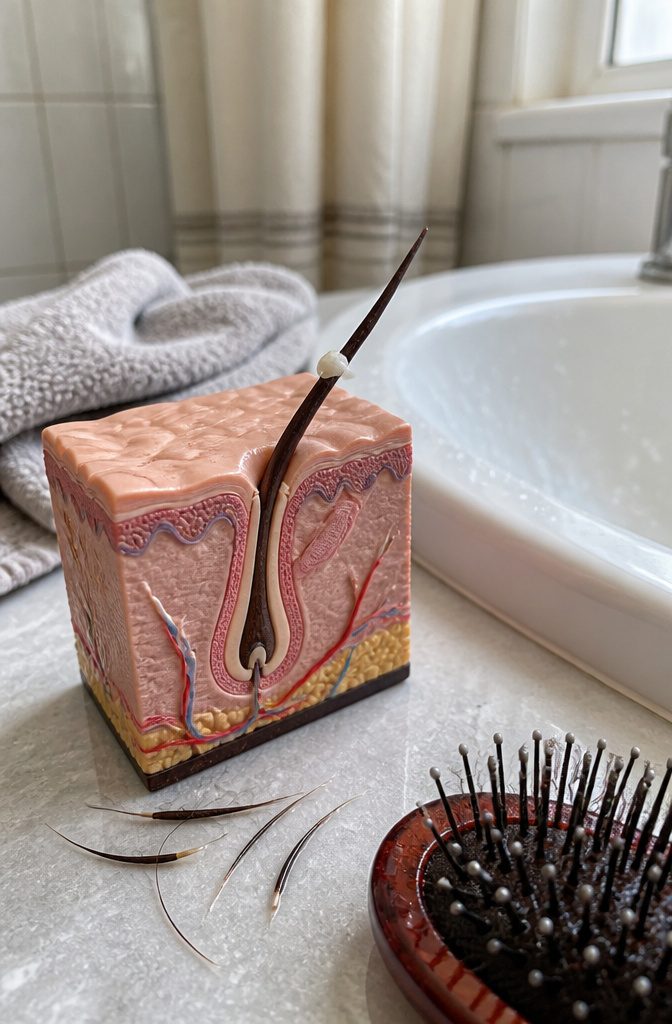
Exogen is the moment when the old hair actually detaches from the follicle and falls away.
Some classification systems fold this into telogen as a final shedding event rather than giving it its own name, while others treat it as a separate fourth phase with distinct molecular signaling that makes the release happen.
Either way, the mechanics are the same: the club hair loosens its anchor and sheds, usually pushed out as the new anagen hair begins growing underneath it.
The timeline ranges from 2 to 5 months, though that window often overlaps with the early growth of the replacement strand.
Brushing, washing and styling all speed up the release of hairs that have already entered exogen, which is why the shower drain and hairbrush catch so many at once.
A healthy scalp sheds 50 to 100 strands daily during this phase, and the shedding only becomes a problem when the new hair fails to grow back at the same thickness or when more hairs enter exogen than anagen can replace.
Why Each Follicle Runs Its Own Schedule
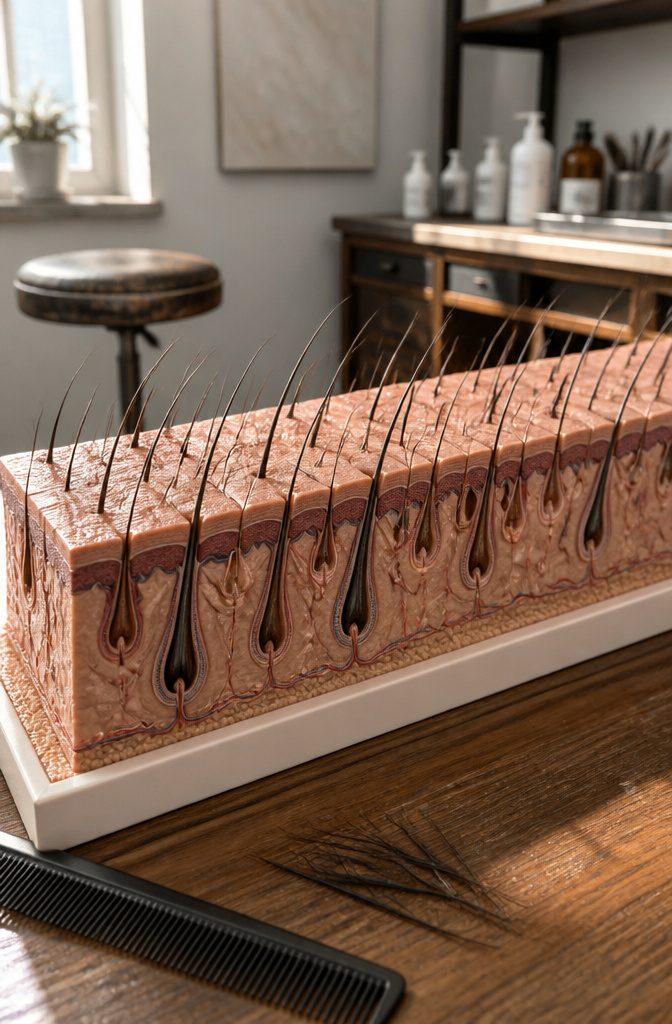
Each follicle cycles on its own clock, completely independent of the others. At any moment, roughly 85–90% of the hair on your scalp sits in the anagen growth phase, while 1–2% transitions through catagen and 10–15% rests in telogen or sheds in exogen.
This staggered timing is the only reason you can lose fifty to a hundred strands a day without your scalp looking thinner.
The hairs falling out today are offset by the thousands still actively growing. If every follicle synchronized and entered the resting phase together, you would see dramatic thinning all at once.
Instead, the lopsided distribution keeps the majority of your hair anchored and lengthening while a small minority releases quietly. The asynchrony is built in, and it holds the whole system in balance.
How Much Daily Shedding Is Normal

A healthy scalp sheds 50–100 hairs per day as part of the exogen phase, though some research extends the upper end to 150.
That range sounds like a lot when you see the strands on your brush, but it represents the normal turnover of follicles that have completed their cycle and released a club hair to make room for the next anagen hair beneath it.
Telling a shed hair from a broken one changes what the number means.
A hair that completed the cycle is full length and carries a small pale bulb at the root end. A broken hair is shorter, lacks that bulb, and points to mechanical damage rather than cycle timing.
If what you are finding in the shower or on your pillow is mostly broken pieces, the conversation shifts from shedding to breakage and the styling or chemical work that caused it.
Shedding that runs well above your normal for months, bald patches, or scalp changes like redness, flaking, pain or scarring are all reasons to see a dermatologist.
A professional can tell whether what you are seeing is normal cycling or something that needs treatment.
Frequently Asked Questions
What are the stages of hair growth?
The hair growth cycle has 4 stages: anagen (active growth), catagen (transition), telogen (rest), and exogen (shedding).
Anagen builds the hair shaft over years, catagen shuts down growth in 2–3 weeks, telogen holds the finished hair in place for 2–4 months, and exogen releases the old strand as a new one grows beneath it.
How long does the anagen phase last?
Anagen lasts 2–7 years on the scalp and accounts for about 85–90% of your hair at any moment.
Genetics determines how long a follicle stays in this phase, which is why some people reach waist length while others plateau at shoulder. Eyebrow follicles stay in anagen for only 2–3 months, keeping brows short.
How fast does hair grow?
Scalp hair grows about 1 centimeter per month during anagen, or roughly 15 centimeters per year. That rate reflects the rapid cell division in the follicle bulb, where cells multiply every 23–72 hours.
What percentage of hair is in the telogen phase?
About 10–15% of scalp hair sits in telogen at any given moment. The resting phase lasts roughly 2–4 months, and during that time the club hair stays anchored without growing while the follicle stays dormant.
What is the exogen phase?
Exogen is when the old hair detaches from the follicle and falls away, usually pushed out as the new anagen hair begins growing underneath.
Some systems fold this into telogen as a final shedding event, while others treat it as a separate fourth phase with distinct molecular signaling.
Why does hair shed months after stress or illness?
Stress, illness, surgery, or nutritional deficiency can push too many follicles into telogen at once, a condition called telogen effluvium. Because the resting phase lasts 2–4 months, the shedding shows up months after the event that triggered it.
What happens during the catagen phase?
Catagen is a 2–3 week transition when growth stops completely, the follicle shrinks to roughly a sixth of its active length, and the hair detaches from the blood supply.
The strand becomes a club hair, anchored only by the outer root sheath, waiting out the final phases before it sheds.
How do I know if my hair is in anagen phase?
Fine baby hairs near your scalp or hairline are a common sign that hair is in the active growth phase. About 85–90% of the hair on your scalp is in anagen at any moment, growing roughly 1 centimeter per month.
Can stress affect the hair growth cycle?
Stress can trigger telogen effluvium by pushing 30–50% of follicles into the resting phase at once instead of the usual 10–15%. The shedding appears 2–4 months later, after the telogen period completes.
Can you increase the anagen phase?
Genetics sets how long a follicle holds in anagen, so you cannot directly lengthen the growth phase. Nutrition, scalp care, and stress management may help support the cycle, but the maximum duration is inherited.
What is the difference between catagen and telogen?
Catagen is a 2–3 week transition when growth stops and the follicle shrinks, while telogen is a 2–4 month resting phase when the dormant follicle holds the finished club hair in place.
Catagen bridges anagen and telogen, shutting down the blood supply before the follicle goes fully dormant.
How long does a hair growth cycle last?
A complete hair growth cycle lasts 2–7 years, with most of that time spent in the anagen growth phase. Catagen adds 2–3 weeks, telogen adds 2–4 months, and exogen overlaps with early regrowth of the replacement strand.