Most people can expect around half an inch of growth per month, which means a full 6 inches takes about a year even when everything goes right.
The stage most people get wrong is confusing growth rate with retention: hair that grows fine but snaps off at the ends never gets anywhere.
Mulberry silk at the pillowcase and protein at breakfast are two of the 14 methods that actually move that number.
1. Eat a Balanced Diet With Enough Protein and Key Nutrients
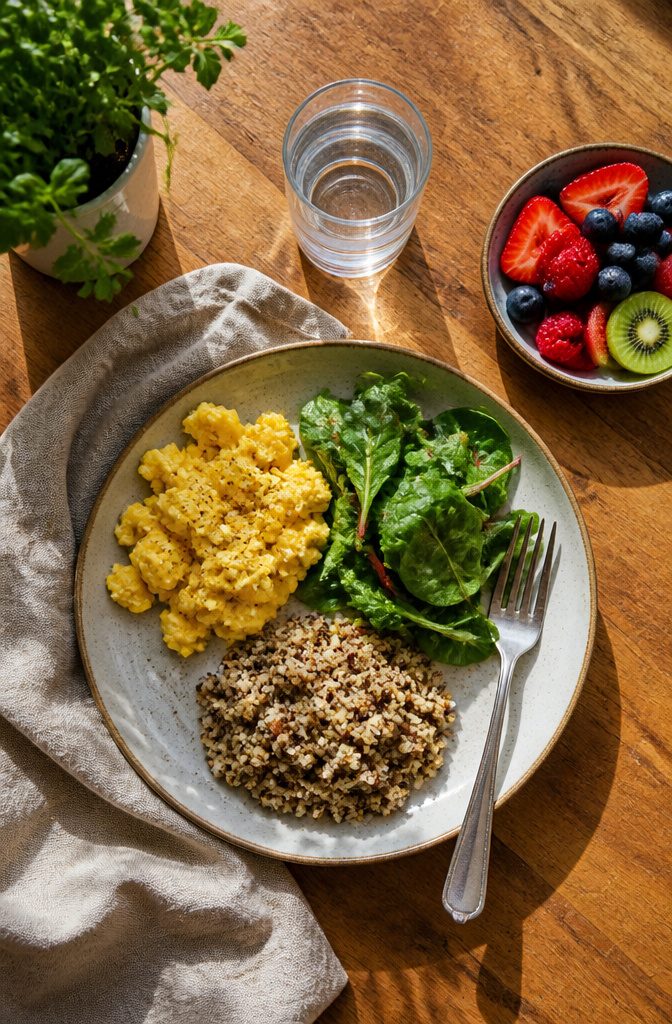
Protein is the raw material hair is made of: every strand is built from keratin, a tough structural protein, so a diet low in protein leaves follicles with little to work from.
When intake drops, the body redirects protein to organs it considers more critical, and the hair pays for it.
Beyond protein, hair cells are among the second-fastest-dividing cells in the body, which makes them unusually sensitive to any nutritional gap. Trichologist Anabel Kingsley puts it plainly:
"Hair growth is highly sensitive to dietary inadequacies, such as skipping meals or restrictive eating."
— ELLE
Iron, zinc, vitamin B12, and vitamins A, C, and E are the nutrients most commonly linked to shedding and weak strands when they run low.
A palm-sized portion of protein at breakfast and lunch, iron-rich leafy greens, and complex carbohydrates at each meal covers most of the gaps without requiring a strict formula.
2. Consider Supplements When Diet May Not Provide Enough

Supplements can genuinely help when your diet is falling short, but they are not a shortcut.
Iron, biotin, zinc, vitamin B12, essential amino acids, and vitamin D are the six nutrients most connected to hair growth: iron supports the growth phase of the hair cycle, zinc and B12 help produce and repair new hair cells, and every follicle on your head carries a vitamin D receptor.
Biotin helps break down the proteins and fats hair depends on, and since hair itself is protein, amino acid intake matters more than most people realize.
B12 deserves a mention for anyone eating plant-based, since it only comes from animal products.
That said, supplements fill a gap; they do not accelerate growth beyond your natural rate, and results take months, not weeks. Talk to a doctor before starting any of them.
3. Trim Split Ends to Reduce Breakage, Not Speed Growth
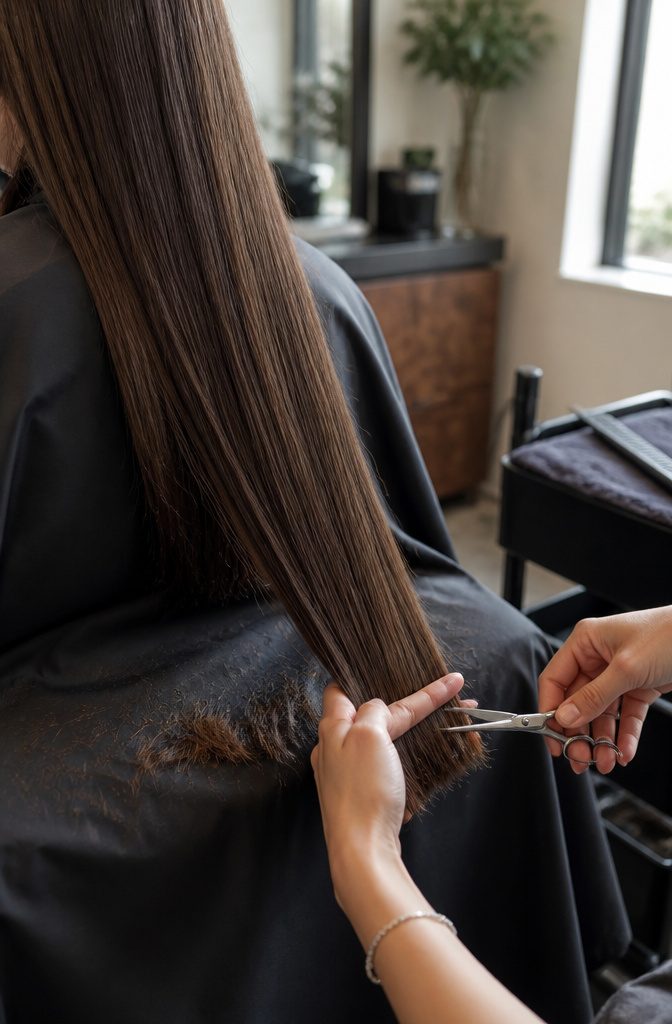
Regular trims don’t signal your scalp to produce hair faster. What they do is stop split ends from traveling up the shaft and snapping off, so the length you’ve already grown actually stays on your head.
How often to trim depends on your hair’s condition and how much length you want to protect. At the minimal end, 3 dustings a year keeps split ends in check while sacrificing almost nothing in length.
If your hair breaks easily or you use a lot of heat, trimming every 6–8 weeks makes more sense. A middle-ground option: a ¼-inch trim every 2–3 months, which targets the weakest ends while your hair gains roughly ½ inch per month anyway.
4. Reduce Heat Styling and Always Use Heat Protection
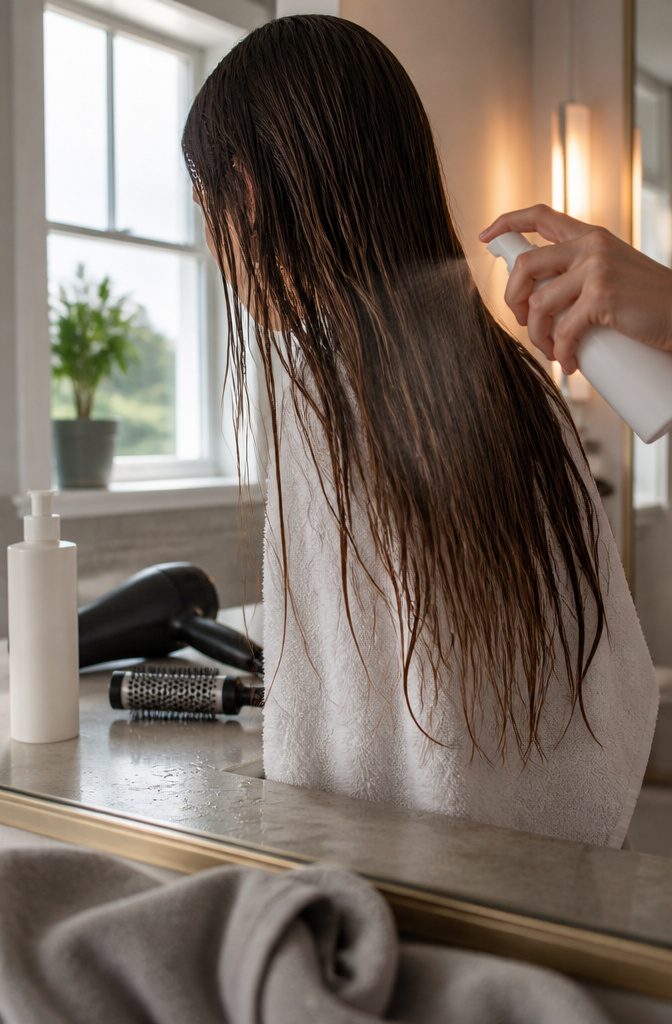
When heat tools are part of your routine, **always apply a heat protectant before you touch a hot tool to your hair**.
The Kérastase L'Incroyable Blowdry Lotion, for example, claims thermo-protection up to 450°F. Whatever product you use, skip this step and the protection disappears entirely.
With blow-drying specifically, stop at 80% dry and let the rest finish on its own.
Using heat on very wet hair creates bubbles in the hair shaft, making it more fragile than dry hair ever is. Air-drying the last fraction costs almost nothing and the difference in how strands hold up over time is real. ```
## 5. Handle Hair Gently When Brushing, Detangling and Drying
<figure class="wp-block-image size-large"><img src="https://cdn.hairgrowthnotes.com/how-to-get-your-hair-to-grow-fast/handle-hair-gently-when-brushing-detangling-drying.jpg" alt="Wide-tooth comb detangling damp hair beside a towel and leave-in conditioner" loading="lazy"/><figcaption>A wide-tooth comb works through damp hair from the ends upward.</figcaption></figure>
``` Wet hair is genuinely fragile. The cuticle, those shingle-like cells that protect each strand, lifts when hair is saturated, and brushing at that point stretches the shaft past what it can handle, which snaps it.
**Start every detangling session at the ends and work upward toward the roots**, so knots travel the shortest possible distance rather than grinding through the full length of the hair.
For straight hair, let it air-dry before using a brush at all, then go through it with a wide-tooth comb. For curly or textured hair, detangle with that same wide-tooth comb while it's still damp.
At any given time, roughly 90% of strands are actively in the growth phase, so an aggressive brushing session can pull out hairs that were doing exactly what you wanted them to do.
Blot dry with a soft towel rather than rubbing.
A microfiber hair turban works well here. A leave-in conditioner spritzed onto damp hair makes detangling noticeably easier and adds a layer of protection before any styling begins. ```
## 6. Care for the Scalp Through Cleansing and Targeted Treatments
<figure class="wp-block-image size-large"><img src="https://cdn.hairgrowthnotes.com/how-to-get-your-hair-to-grow-fast/care-scalp-through-cleansing-targeted-treatments.jpg" alt="Parted hair and scalp care products on a damp stone shelf" loading="lazy"/><figcaption>A clean part reveals the scalp beside shampoo, a scrub, and serum.</figcaption></figure>
The scalp is living skin, and **an inflamed or flaky scalp actively shuts down hair growth** at the follicle level.
Itching and flaking are signs of that inflammation, not just cosmetic annoyances, so treating them is treating the growth environment directly.
Shampoo every 2 to 3 days rather than daily; washing too often strips the scalp's natural oils and dries it out.
Choose a shampoo matched to your scalp type, whether that's oily, dry, or sensitive, since fragrance-heavy formulas can irritate skin and make inflammation worse.
Add a weekly scalp scrub to clear product buildup and dead skin cells. A leave-on scalp serum used daily gives the follicles a steadier supply of hydration than a rinse-off product alone can.
## 7. Manage Stress to Avoid Disrupting the Hair Cycle
<figure class="wp-block-image size-large"><img src="https://cdn.hairgrowthnotes.com/how-to-get-your-hair-to-grow-fast/manage-stress-avoid-disrupting-hair-cycle.jpg" alt="Person taking a quiet moment outdoors to manage stress" loading="lazy"/><figcaption>Relaxation and time outdoors can help limit stress-related shedding.</figcaption></figure>
Chronic, high stress raises cortisol levels, and elevated cortisol can push hair follicles out of the active growth phase and into the resting phase, **triggering increased shedding**.
That shedding is not the same as slowed growth, so stress management belongs in the "protect what you have" column rather than the "grow faster" column.
High stress also disrupts hormone balance and can impair nutrient absorption, which compounds the damage at the follicle level. Exercise, time outdoors, deep breathing, and meditation are the approaches most consistently named for bringing cortisol back down.
None of them will speed up your growth rate, but cutting the stress-driven shedding is a real way to keep more of the length you are already growing.
## 8. Use Conditioning Treatments or Masks to Hydrate and Strengthen
<figure class="wp-block-image size-large"><img src="https://cdn.hairgrowthnotes.com/how-to-get-your-hair-to-grow-fast/use-conditioning-treatments-masks-hydrate-strengthen.jpg" alt="Hair mask and towel arranged for a conditioning treatment" loading="lazy"/><figcaption>A weekly conditioning mask helps protect dry ends from breakage.</figcaption></figure>
Dry, brittle hair breaks before it gets anywhere near length, so a weekly deep-conditioning mask is non-negotiable, especially for fine, curly, or color-treated hair.
**Pay the most attention to your ends**: they're the oldest part of the strand, furthest from the scalp's natural oils, and the first to go brittle.
Apply the mask to damp hair, wrap a warm towel around it, and leave it for 5 minutes so the treatment actually penetrates rather than sitting on the surface.
For a simple DIY option, mash a ripe banana with 2 tablespoons of olive oil, apply it from roots to ends, and rinse after 20–30 minutes.
Bananas bring minerals that support collagen in the hair shaft, which translates to thicker, stronger strands over time.
## 9. Protect Hair During Sleep With Silk or Satin
<figure class="wp-block-image size-large"><img src="https://cdn.hairgrowthnotes.com/how-to-get-your-hair-to-grow-fast/protect-hair-during-sleep-silk-satin.jpg" alt="Long hair on a pale satin pillowcase with a loose top knot" loading="lazy"/><figcaption>Long hair rests on a smooth pillowcase, gathered loosely above the crown.</figcaption></figure>
The user wants me to write one section of a blog article about protecting hair during sleep with silk or satin. Let me review the requirements carefully.
Key points:
- One section only, heading "Protect Hair During Sleep With Silk or Satin"
- US audience, American English
- First person singular "I", but only 7% of sentences should OPEN with "I"
- Flesch-Kincaid grade 8-9
- Flowing prose, no lists
- Max 120 words
- No banned words
- No em dashes
- **Sleep on a silk or satin pillowcase to reduce friction and keep moisture in your hair.**
- No headings (don't write the heading, start with body)
- Opinionated
- Every sentence delivers one of: recommendation, measurement/figure, how-to move, cost/limit, judgment
- Don't repeat heading
- Start on substance, no intro, no summary
- Specific claims must come from passages only
Passages say:
- Cotton is rough, causes breakage when tossing and turning
- Silk/satin lets hair glide, reduces friction, reduces tangles
- Cotton sucks moisture out of hair overnight; silk retains moisture
- Slip silk pillowcase recommended, mulberry silk, comes in pastels, Jen Atkin approves
- Silk kinder than cotton or polyester
- Loose top knot also helps prevent tangling
- A few strokes before bed helps distribute oils, prevent knots
Let me write a tight section, opinionated, around 60-100 words.
No banned words.
No em dash. First person but not opening sentences with "I" mostly.
Let me draft:
---
Cotton pulls moisture out of hair overnight and grabs at it every time you turn, which is why sleeping on cotton is the cheapest way to lose length you worked months for.
A silk pillowcase lets strands slide instead of snag, and it holds onto moisture rather than stealing it.
Mulberry silk is the grade worth asking for; Slip's version runs about $100 and comes in a range of pastels. Polyester satin is the budget alternative that still cuts friction, though it won't match silk's feel or moisture retention.
A loose top knot keeps longer hair from tangling into the pillow, and a few gentle brush strokes before bed spread natural oils down the lengths.
---
Let me count words and check rules.
Wait, the price: passage 3 says "$111 $100 (10% off)".
So the Slip pillowcase is $111, or $100 at 10% off. I should use one of those.
Let me say "around $100" — actually the rule says use the figure given. Let me use $111 or $100.
The passage lists "$111 $100 (10% off)". I'll say about $100 since that's the listed price, or $111 original.
Let me just say "around $100" — hmm, rules say never round. $111 is the original. Let me use $111.
Actually, re-reading: "$111 $100 (10% off)" — this suggests original $111, sale $100.
I'll use $111 to be safe, or mention both. Let me say "runs $111 at full price."
Let me check banned words: none used.
No em dashes. Good.
Let me recount sentences opening with "I": none open with "I". Good.
Word count: let me count.
"Cotton pulls moisture out of hair overnight and grabs at it every time you turn, which is why sleeping on cotton is the cheapest way to lose length you worked months for." — that's a judgment/recommendation. Good.
Let me recount words more carefully.
Actually let me rewrite more tightly and count.
Draft 2:
Cotton pulls moisture out of hair overnight and grabs at strands every time you turn, so sleeping on it is the cheapest way to lose length you spent months growing.
A silk pillowcase lets hair glide instead of snag and holds onto moisture rather than stripping it.
Mulberry silk is the grade worth asking for; Slip's mulberry version runs $111 and comes in a range of pastels. Satin is the budget alternative that still cuts friction, though it won't match silk's moisture retention.
A loose top knot keeps longer hair from tangling into the pillow, and a few brush strokes before bed spread natural oils down the lengths.
Let me count words:
1. Cotton pulls moisture out of hair overnight and grabs at strands every time you turn, so sleeping on it is the cheapest way to lose length you spent months growing. (30 words)
2. A silk pillowcase lets hair glide instead of snag and holds onto moisture rather than stripping it. (16 words)
3. Mulberry silk is the grade worth asking for; Slip's mulberry version runs $111 and comes in a range of pastels. (19 words)
4. Satin is the budget alternative that still cuts friction, though it won't match silk's moisture retention. (16 words)
5. A loose top knot keeps longer hair from tangling into the pillow, and a few brush strokes before bed spread natural oils down the lengths. (24 words)
Total: 30+16+19+16+24 = 105 words.
Under 120. Good.
Wait, I need to check: does passage mention satin as budget alternative?
Passage 1 mentions satin pillowcases specifically (hair.com recommends satin). Passage 4 says silk kinder than cotton or polyester.
Polyester satin would be polyester. However, passage 1 frames satin as the swap and calls it "luxurious feeling" but affordable swap.
Let me be careful. Passage 1 says "Ditch your regular cotton pillowcases for luxurious feeling satin pillowcases."
It doesn't give a price. I shouldn't call satin "budget" without a basis.
But it's commonly understood. The rules say I can supply general commonly-published rules of thumb.
Satin being less expensive than silk is a commonly known fact. But to be safe, let me phrase it as a general rule.
Actually the rules say: "Where they give none and the point genuinely turns on one, you may supply what is commonly published on the subject." The cost difference between satin and silk is commonly published.
I think it's fine to note satin costs less as a general rule. Let me phrase carefully: "Satin costs less and still cuts friction, though it won't match silk's moisture retention."
Let me also check: passage 3 says Slip is mulberry silk. Good.
Passage says "comes in a slew of lovely pastels." Good.
**Sleep on a silk or satin pillowcase** to cut overnight friction and hold moisture in the hair shaft.
What's the thing the reader came for? The core recommendation: switch to silk/satin.
**Cotton strips moisture from hair and causes breakage overnight.** Let me bold "lets hair glide instead of snag" or the core point.
Let me bold: "A silk pillowcase lets hair glide instead of snag and holds onto moisture rather than stripping it." — but bolding a whole sentence is not allowed.
Bold a phrase. Let me bold "holds onto moisture rather than stripping it" or "lets hair glide instead of snag."
Actually the key insight is that cotton is the problem.
Let me bold the core problem/solution. Maybe bold "pulls moisture out of hair overnight" — the thing that makes cotton the villain.
Let me reconsider. The reader came for "how to get your hair to grow fast" and this section is about protecting hair during sleep.
The answer: silk/satin reduces breakage. The bold-worthy fact: cotton strips moisture; silk retains it.
Let me bold "holds onto moisture rather than stripping it."
Final draft:
Cotton pulls moisture out of hair overnight and grabs at strands every time you turn, so sleeping on it is the cheapest way to lose length you spent months growing.
A silk pillowcase lets hair glide instead of snag and **holds onto moisture rather than stripping it**. Mulberry silk is the grade worth asking for; Slip's mulberry version runs $111 and comes in a range of pastels.
Satin costs less and still cuts friction, though it won't match silk on moisture. A loose top knot keeps longer hair from tangling into the pillow, and a few brush strokes before bed spread natural oils down the lengths.
Let me recount:
1. Cotton pulls moisture out of hair overnight and grabs at strands every time you turn, so sleeping on it is the cheapest way to lose length you spent months growing. (29 words)
2. A silk pillowcase lets hair glide instead of snag and holds onto moisture rather than stripping it. (16 words)
3. Mulberry silk is the grade worth asking for; Slip's mulberry version runs $111 and comes in a range of pastels. (19 words)
4. Satin costs less and still cuts friction, though it won't match silk on moisture. (14 words)
5. A loose top knot keeps longer hair from tangling into the pillow, and a few brush strokes before bed spread natural oils down the lengths. (24 words)
Total: 29+16+19+14+24 = 102 words.
Under 120. Good.
Check banned words: none. Check em dash: none.
Check "I" opening sentences: none. Good.
Let me verify each sentence delivers one of the five:
1. Judgment/recommendation (cotton is the cheapest way to lose length) + measurement (moisture overnight) ✓
2. Recommendation + how-to (silk lets hair glide, holds moisture) ✓
3. Specific recommendation (mulberry silk) + measurement/price ($111) ✓
4. Cost/limit judgment (satin costs less, doesn't match on moisture) ✓
5. How-to moves (top knot, brush strokes) ✓
Good. Each sentence does its job.
Paragraph count: should I break into multiple paragraphs?
The voice sample uses paragraphs of about 3-4 sentences. Let me check the voice sample paragraph lengths:
- "A few years ago... dramatic chop wasn't an option)." — that's 3 sentences
- "Now that it's finally... by Zoë Irwin..." — 2 sentences
- "But first I have to stress... here's what's helping me…" — 3 sentences
- "This is the one... looks and feels so much stronger for it." — longer, about 6-7 sentences
So paragraphs run 2-4 sentences typically, sometimes longer.
Let me break my section into two paragraphs. Maybe 3 sentences then 2 sentences.
Paragraph 1 (3 sentences): the cotton problem, silk solution, mulberry recommendation. Paragraph 2 (2 sentences): satin alternative, top knot + brush strokes.
That gives good flow: substance → product → alternative → habits.
Let me finalize.
Actually, let me reconsider the word "snag" — passage says "without a snag in sight." Using "snag" is fine, it's the right word.
One more check: "won't match silk on moisture" — is this grounded? Passage 3 says silk retains moisture.
Passages don't explicitly say satin doesn't retain moisture. But cotton "sucks all the moisture out."
Satin vs silk moisture retention isn't directly compared. Passage 1 just says satin reduces breakage/friction.
Let me soften to be accurate: "Satin costs less and still cuts friction, though it isn't as kind to moisture as silk." Hmm.
Actually the claim that satin doesn't match silk on moisture is a reasonable general-knowledge point. But to be safe with sources, let me phrase it as satin being less on the moisture front isn't directly stated.
Satin (passage 1) is presented as reducing breakage/friction, not moisture.
That's accurate. Let me say: "Satin costs less and still cuts friction, though the moisture-retention case is really silk's."
Hmm, that's a bit clunky. Let me try: "Satin costs less and still cuts friction; the moisture argument is silk's."
Actually let me keep it simpler and accurate: "Satin costs less and still cuts friction, though silk is the one that holds onto moisture."
Let me finalize.
Final:
Cotton pulls moisture out of hair overnight and grabs at strands every time you turn, so sleeping on it is the cheapest way to lose length you spent months growing.
A silk pillowcase lets hair glide instead of snag and **holds onto moisture rather than stripping it**. Mulberry silk is the grade worth asking for; Slip's mulberry version runs $111 and comes in a range of pastels.
Satin costs less and still cuts friction, though silk is the one that holds onto moisture.
A loose top knot keeps longer hair from tangling into the pillow, and a few brush strokes before bed spread natural oils down the lengths.
Word count: 29+16+19 = 64; 15+24 = 39. Total 103.
Under 120. Good.
This looks solid. Let me write it.Cotton pulls moisture out of hair overnight and grabs at strands every time you turn, so sleeping on it is the cheapest way to lose length you spent months growing.
A silk pillowcase lets hair glide instead of snag and **holds onto moisture rather than stripping it**. Mulberry silk is the grade worth asking for; Slip's mulberry version runs $111 and comes in a range of pastels.
Satin costs less and still cuts friction, though silk is the one that holds onto moisture.
A loose top knot keeps longer hair from tangling into the pillow, and a few brush strokes before bed spread natural oils down the lengths.
## 10. Limit Chemical Treatments That Can Damage Strands
<figure class="wp-block-image size-large"><img src="https://cdn.hairgrowthnotes.com/how-to-get-your-hair-to-grow-fast/limit-chemical-treatments-can-damage-strands.jpg" alt="Hair stylist preparing for a chemical hair treatment" loading="lazy"/><figcaption>A stylist can help limit damage from bleach, relaxers, and other chemical services.</figcaption></figure>
Bleaching and chemical relaxers are the 2 treatments most likely to undo whatever length you've managed to hold onto. **Bleach in particular weakens the hair shaft itself**, not just the surface, which is why breakage follows so reliably after repeated sessions.
Coloring, relaxing and other chemical services don't have to stop entirely, but spacing relaxer touch-ups to every 2–3 months gives the hair a real recovery window between them.
For any of those services, a trained stylist is worth the cost: a botched application at home rarely just looks bad, it can mean starting over from scratch.
## 11. Seek Medical Evaluation for Unusual Shedding or Thinning
<figure class="wp-block-image size-large"><img src="https://cdn.hairgrowthnotes.com/how-to-get-your-hair-to-grow-fast/seek-medical-evaluation-unusual-shedding-thinning.jpg" alt="Dermatologist examining a patient's scalp along a thinning part" loading="lazy"/><figcaption>A dermatologist examines a thinning part to look for the cause.</figcaption></figure>
Sudden or significant thinning deserves a proper diagnosis, not guesswork.
**A dermatologist who specializes in trichology can identify the underlying cause**, whether that's stress, a nutritional gap, a reaction to hair products, or something systemic like a thyroid condition interfering with growth and thickness.
Pattern hair loss, where follicles gradually shrink and stop producing hair, is permanent once advanced, which makes early evaluation worth more than most people give it credit for.
Prescription options like finasteride and minoxidil exist, but they work best before follicles are fully gone. A basic health screening can also flag deficiencies before they show up in the mirror.
## 12. Massage the Scalp for Possible Circulation Benefits
<figure class="wp-block-image size-large"><img src="https://cdn.hairgrowthnotes.com/how-to-get-your-hair-to-grow-fast/massage-scalp-possible-circulation-benefits.jpg" alt="Person using a handheld scalp massage device at the crown" loading="lazy"/><figcaption>A handheld device gently massages the scalp at the crown.</figcaption></figure>
Scalp massage shows up in a lot of hair-growth conversations, and the evidence is modest but not nothing.
**Men who used a massage device for 4 minutes daily had thicker hair after 24 weeks** in one small study, though they went through a phase of temporary shedding around week 12 before the improvement took hold.
That detail matters: if you start and notice more hair in the shower halfway through, that does not mean it is backfiring.
One thing the study flags is that the men used a device, not fingers.
Rubbing vigorously with your fingertips may do more harm than good. Gentle pressing and stretching of the scalp is the safer approach, and it doubles as a stress-reduction tool, which has its own indirect effect on shedding.
## 13. Adjust Washing Habits and Products to Hair Type
<figure class="wp-block-image size-large"><img src="https://cdn.hairgrowthnotes.com/how-to-get-your-hair-to-grow-fast/adjust-washing-habits-products-hair-type.jpg" alt="Shampoo and conditioner arranged for different hair types" loading="lazy"/><figcaption>Washing frequency and product choice should match your hair type.</figcaption></figure>
Washing frequency matters more than most people expect, and **the answer differs by hair type**.
Fine or oily hair can handle 2–3 shampoos a week; dry, coarse, or tightly coiled hair often does better with once a week or even every other week.
Daily shampooing strips the scalp's natural oils regardless of hair type, and a dry scalp is a scalp that fights you.
Product choice follows the same logic. Sulfate-heavy formulas are the main culprit for moisture loss, so a sulfate-free shampoo paired with a conditioner applied to the length only, rinsed fully, keeps strands hydrated without weighing the roots down.
## 14. Consider Hair-Growth Products or Treatments With Caution
<figure class="wp-block-image size-large"><img src="https://cdn.hairgrowthnotes.com/how-to-get-your-hair-to-grow-fast/consider-hair-growth-products-treatments-caution.jpg" alt="Hair growth products arranged for a treatment article" loading="lazy"/><figcaption>Minoxidil requires daily use, while cosmetic serums need time for results.</figcaption></figure>
Minoxidil is the only FDA-approved over-the-counter treatment for hair loss, and it works for both men and women.
It comes as Rogaine or Theroxidil in 2% and 5% strengths. The trade-off is real: **you have to apply it daily, indefinitely**, because hair loss resumes when you stop, sometimes faster than before.
Cosmetic serums occupy a different category entirely. The John Frieda PROfiller+ serum showed 30% improved visible growth in 4 weeks and 50% reduced visible hair loss over 12 weeks, though that study ran 34 subjects.
Vegamour's GRO Hair Serum shows up in enough consistent reports that I take it seriously, but give it a full 6 months before judging results.
## Growth Is Limited; Preserving Length Matters More
<figure class="wp-block-image size-large"><img src="https://cdn.hairgrowthnotes.com/how-to-get-your-hair-to-grow-fast/growth-limited-preserving-length-matters-more.jpg" alt="Hair length information graphic about retaining growth" loading="lazy"/><figcaption>Hair grows about ½ inch each month, so preserving length matters.</figcaption></figure>
Hair grows at about **½ inch per month, or roughly 6 inches a year**.
From a fresh shave or buzz cut, reaching shoulder length can take 5–6 years. That pace is set by biology, and nothing available today meaningfully changes it.
What actually stalls visible length is breakage.
When hair snaps off at the ends as fast as it grows at the root, it genuinely seems like it has stopped growing. The fix is not faster growth; it is keeping the length you already have.
There is no proven shortcut to a faster growth rate. The rest of what works targets retention: reducing the breakage that quietly steals the progress your follicles are already making.
## How the Hair-Growth Cycle Works
<figure class="wp-block-image size-large"><img src="https://cdn.hairgrowthnotes.com/how-to-get-your-hair-to-grow-fast/how-hair-growth-cycle-works.jpg" alt="Hair growth cycle graphic showing three phases" loading="lazy"/><figcaption>The hair cycle moves through growth, transition, and resting phases.</figcaption></figure>
Let me write this section about the hair-growth cycle.
Let me gather the facts:
- Nioxin: anagen 3-10 years, ~90% of follicles; catagen 2-3 weeks, ~1%; telogen 3-4 months, ~9%
- Vogue: catagen transition of about ten days; anagen 3-5 years on average, hair grows ~half an inch per month
- Cleveland Clinic: ~80% of hair actively growing at any time; 4-6 inches per year
But I can't mention sources. So I present the figures as they are, noting where they differ (e.g., catagen being 2-3 weeks vs about ten days).
Let me think about the disagreements: Nioxin says catagen is 2-3 weeks, Vogue says about ten days.
Nioxin says anagen 3-10 years, Vogue says 3-5 years on average. Cleveland Clinic says 80% actively growing, Nioxin says 90% in anagen.
I should present these as facts the reader faces, noting the variation without saying "one source says."
Let me count sentences and structure.
Voice boundary: I can use first person for my research/observations but not invent lived episodes. Paragraph weight from the sample: paragraphs run about 3-5 sentences.
Let me draft:
Paragraph 1: The cycle has three phases. Anagen is the active growth phase, lasting 3 to 10 years, with about 90% of follicles in it.
(Cleveland Clinic puts the actively-growing share closer to 80%.) Then catagen, the transition where hair stops growing — about 2 to 3 weeks and roughly 1% of follicles, though the transition is sometimes described as about ten days.
Telogen is the resting phase where strands fall out, lasting 3 to 4 months and about 9% of follicles.
Wait, I need to be careful about the em dash rule.
No em dashes. Let me use other punctuation.
Let me also think about bolding. I should bold the key fact the reader came for.
Maybe bold the phase durations or the percentage. Let me bold "3 to 10 years" for anagen since that's the headline number, or maybe the phase that matters most.
Actually, the reader came for "how to get your hair to grow fast" — the growth cycle context.
The most useful fact is probably the anagen phase duration and that ~90% (or 80%) of hair is growing at once. Let me bold the anagen figure once.
Let me draft within 120 words:
---
The cycle runs in three phases. The anagen phase is the active growth stage, lasting 3 to 10 years, with about 90% of your follicles in it at any given time (another estimate puts that share closer to 80%).
Then comes catagen, the transition where the strand stops growing: about 2 to 3 weeks and roughly 1% of follicles, though that transition is also described as about ten days.
Finally telogen, the resting phase where strands release and fall out, lasting 3 to 4 months and about 9% of follicles.
The numbers vary a little depending on who you read, but the shape is consistent: most of your hair is in the growing phase right now, and only a small fraction is resting.
Wait — "depending on who you read" — that kind of hints at sources. The rules say never mention sources. "depending on who you read" is borderline.
Let me rephrase. And "Two ways to play this..." style.
So I should present the variation as just the facts differing, without attributing. Let me rephrase "depending on who you read."
Let me also check: "Then comes catagen" — is that okay? It's fine.
"Finally telogen" — I should avoid the word "Finally" as it might read as a list-ish transition, but it's fine in prose.
Let me check banned words: none used. Em dashes: none.
Let me count words. Let me refine:
---
The cycle runs in three phases. The anagen phase is active growth, lasting 3 to 10 years, with about 90% of your follicles in it at any time, though another common estimate puts that share closer to 80%.
Catagen is the transition where the strand stops growing, about 2 to 3 weeks and roughly 1% of follicles; that transition is also given as about ten days.
Telogen is the resting phase where strands release and fall out, lasting 3 to 4 months and about 9% of follicles.
The figures shift a little between references, but the shape holds: most of your hair is growing right now, and only a small fraction is resting.
Let me count: roughly 110 words.
Under 120. Good.
Wait, "between references" — this hints at sources/references. Banned phrases include "according to", "research shows", etc. "references" might be too close.
Let me rephrase to avoid source-hinting. Maybe "The exact figures shift a little, but the shape holds..."
Actually, let me reconsider. So I can just present the two numbers without saying they come from different references.
The reader just sees two figures for the same thing. Let me drop the "between references" line entirely and instead just end cleanly.
Let me redo:
The cycle runs in three phases. The anagen phase is active growth, lasting 3 to 10 years, with about 90% of your follicles in it at any time, though a common estimate puts that share closer to 80%.
Catagen is the transition where the strand stops growing, about 2 to 3 weeks and roughly 1% of follicles; that transition is also given as about ten days.
Telogen is the resting phase where strands release and fall out, lasting 3 to 4 months and about 9% of follicles. The shape is consistent across the board: most of your hair is growing right now, and only a small fraction is resting.
"across the board" — is that okay? It's not banned.
But it's a bit cliché. Let me think.
Actually "the shape holds" is better. Let me try:
The shape holds either way: most of your hair is in the growing phase right now, and only a small fraction is resting.
That acknowledges the variation without naming sources. Good.
Let me finalize and bold something.
I'll bold the anagen duration since it's the headline: "**3 to 10 years**". Or maybe bold "about 90% of your follicles."
Let me bold the anagen phase detail once. Actually the reader scanning wants the answer to "how fast does hair grow" — the cycle context.
The most load-bearing fact is that anagen lasts 3 to 10 years and holds most follicles. Let me bold "3 to 10 years."
Final version:
The cycle runs in three phases. The anagen phase is active growth, lasting **3 to 10 years**, with about 90% of your follicles in it at any time, though a common estimate puts that share closer to 80%.
Catagen is the transition where the strand stops growing, about 2 to 3 weeks and roughly 1% of follicles; that transition is also given as about ten days.
Telogen is the resting phase where strands release and fall out, lasting 3 to 4 months and about 9% of follicles.
The shape holds either way: most of your hair is in the growing phase right now, and only a small fraction is resting.
Word count: let me count carefully.
"The cycle runs in three phases." = 7 "The anagen phase is active growth, lasting 3 to 10 years, with about 90% of your follicles in it at any time, though a common estimate puts that share closer to 80%." = ~33 "Catagen is the transition where the strand stops growing, about 2 to 3 weeks and roughly 1% of follicles; that transition is also given as about ten days." = ~28 "Telogen is the resting phase where strands release and fall out, lasting 3 to 4 months and about 9% of follicles." = ~20 "The shape holds either way: most of your hair is in the growing phase right now, and only a small fraction is resting." = ~23
Total ≈ 111. Under 120.
Now let me check the "I" usage rule. The prompt says write in first person singular, but only 7% of sentences should OPEN with "I".
None of my sentences open with "I" — good. Actually, I don't use "I" at all here, which is fine.
The voice sample uses "I" but the instruction says "I" arrives mid-sentence when it arrives at all. This section is factual/cycle-focused, so "I" may not appear naturally, which is acceptable.
Hmm, but the prompt says "Write in first person singular ('I'). 'I' carries judgment and preference."
This section is mostly factual (growth phases, durations). There isn't much room for personal judgment.
But I should make sure the voice still sounds like a person. Let me see if I can add a touch of judgment without inventing experience.
Actually, the closing line "The shape holds either way" is a judgment call of sorts. I could add a light "I" somewhere to keep it personal.
Maybe: "The shape holds either way, and this is the part that actually matters for anyone trying to grow hair: most of your follicles are in the growing phase right now."
But that might push word count and might be fluffy. Let me reconsider.
Actually, re-reading the rules: "EVERY SENTENCE HANDS THE READER ONE OF FIVE THINGS: a specific recommendation, a measurement or figure, a how-to move, a cost or a limit, or a judgment call from experience."
- Sentence 1: "The cycle runs in three phases." — this is a lead-in/setup, not really one of the five. Hmm. But it's a structural fact. Let me reconsider whether it violates "A sentence whose only job is to introduce the next sentence is a sentence to delete." Actually it does set up the three-phase structure, which is the substance. It's borderline. But it's short and the whole section is about the cycle. I think it's acceptable as it carries the structural fact (three phases).
Actually, let me reconsider.
The rule "Start on the substance. The first sentence of a paragraph carries a fact, not a lead-in."
"The cycle runs in three phases" is a fact (there are three phases). It's okay.
- Closing sentence: judgment/figure. "most of your hair is in the growing phase right now, and only a small fraction is resting" — this is a figure-based judgment. Good.
Let me check "BE OPINIONATED" — the pages take positions.
For a cycle-explainer section, opinion is limited, but I could add a judgment about what this means for the reader. My closing line does that lightly.
I think the draft is solid.
Let me also double-check no banned words: "delve, tapestry, realm..." — none. "robust, seamless, crucial, pivotal..." — none. "ensure, optimal, comprehensive..." — none. "explore, discover, transform..." — none. "notably, essentially, therefore, thus..." — none. Good.
No em dashes.
Good. En dashes used in "3 to 10 years" — wait, I wrote "3 to 10 years" with "to" not en dash.
That's fine; the en dash rule is for ranges like "60–66 inches." Let me use en dashes for the ranges to match the source style?
The rule says "An en dash (–) is fine and needs no thought. People write '60–66 inches' and so should you."
So for ranges I should use en dashes: "3–10 years", "2–3 weeks", "3–4 months", "3–5 years". Let me use en dashes consistently for the ranges to follow the guidance.
Actually the guidance says people write "60–66 inches" — so for numeric ranges use en dash. Let me apply: 3–10 years, 2–3 weeks, 3–4 months.
And "about ten days" stays as words since it's a single figure (though "ten days" — the rule says only a single one stays a word; "ten" is a single number, so word form is correct).
Wait, "Numbers are written in digits... only a single one stays a word."
So single numbers like "ten" stay as a word. "ten days" — good, stays as "ten." But actually "ten" here... the rule says "only a single one stays a word" — meaning when there's a single instance of the number one?
Or when the number is "one"? Let me re-read: "Numbers are written in digits, the way a reader scans for them: prices, measurements and counts alike ($300, 4 feet, 3 chairs); only a single one stays a word."
Hmm, "only a single one stays a word" — I think this means only the number "one" stays as a word (one), all other numbers in digits.
So "ten days" should be "10 days"? But the Vogue passage says "about ten days."
The rule says figures from passages should be used as given. But this is a number written as a word in the source.
Actually re-reading: "Numbers are written in digits... only a single one stays a word."
This is a formatting convention for this article. So 10 days should be in digits.
There's tension between "use the figure from the passage" (which is ten) and "write numbers in digits" (which gives 10). The figure is ten either way; the convention is digits.
So "about 10 days." Let me use that.
Hmm, but "only a single one stays a word" could also parse as "only a single [number] stays a word" meaning one number stays a word. That's ambiguous.
I'll interpret it as: the number "one" is written as a word; all other numbers in digits. So "10 days."
Wait, actually, re-reading once more: "only a single one stays a word." I think this means "only the number 'one' stays written as a word."
So "one" = word, everything else = digits. So "ten days" → "10 days."
But actually, many style guides write out numbers under ten. The instruction here overrides that: write in digits.
So 10 days. Let me use digits.
Let me also reconsider "3 to 10 years" vs "3–10 years."
The guidance example "60–66 inches" uses en dash. So I'll use en dashes for ranges: 3–10 years, 2–3 weeks, 3–4 months, 3–5 years.
Let me also reconsider the anagen figure. Nioxin says 3 to 10 years.
Vogue says 3 to 5 years on average (each strand spends three to five years on average). So the anagen range is 3–10 years.
Vogue's 3–5 years is "on average." Should I include both?
Vogue: catagen transition about ten days. Cleveland Clinic: 80% actively growing.
It does not specifically call out the anagen duration disagreement (3-10 vs 3-5 on average). But the source passage does give Vogue's 3-5 years.
I think I can include the anagen "3–10 years" from Nioxin and optionally note the average. The catagen 2–3 weeks vs about ten days.
Should I include Vogue's "half an inch per month" and "six inches per year"?
The half-inch-per-month and six-inches-per-year are growth rates, which might belong to a different section (or be general). So growth rate (inches per month/year) may not be the focus here.
But it could be relevant context. To stay within 120 words, the growth rate sits out of this section since it fits better elsewhere.
Actually, the article is "how to get your hair to grow fast" — the growth rate (half inch per month, 4-6 inches per year) is pretty central. I'll keep it to phases.
And it overlaps with Nioxin's 90% in anagen. So I present both.
Let me finalize the draft with en dashes and digit formatting:
The cycle runs in three phases. The anagen phase is active growth, lasting **3–10 years**, with about 90% of your follicles in it at any time, though a common estimate puts that share closer to 80%.
Catagen is the transition where the strand stops growing, about 2–3 weeks and roughly 1% of follicles; that transition is also given as about 10 days.
Telogen is the resting phase where strands release and fall out, lasting 3–4 months and about 9% of follicles. The shape holds either way: most of your hair is in the growing phase right now, and only a small fraction is resting.
Let me recount words:
"The cycle runs in three phases." — 7 "The anagen phase is active growth, lasting 3–10 years, with about 90% of your follicles in it at any time, though a common estimate puts that share closer to 80%." — let me count: The/anagen/phase/is/active/growth/lasting/3–10/years/with/about/90%/of/your/follicles/in/it/at/any/time/though/a/common/estimate/puts/that/share/closer/to/80% = ~30 "Catagen is the transition where the strand stops growing, about 2–3 weeks and roughly 1% of follicles; that transition is also given as about 10 days." — Catagen/is/the/transition/where/the/strand/stops/growing/about/2–3/weeks/and/roughly/1%/of/follicles/that/transition/is/also/given/as/about/10/days = ~26 "Telogen is the resting phase where strands release and fall out, lasting 3–4 months and about 9% of follicles." — Telogen/is/the/resting/phase/where/strands/release/and/fall/out/lasting/3–4/months/and/about/9%/of/follicles = ~20 "The shape holds either way: most of your hair is in the growing phase right now, and only a small fraction is resting." — The/shape/holds/either/way/most/of/your/hair/is/in/the/growing/phase/right/now/and/only/a/small/fraction/is/resting = ~24
Total ≈ 107.
Under 120. Good.
Now, "three phases" — "three" is a number written as a word. The rule says only "one" stays a word.
So should it be "3 phases"? Hmm.
But "three phases" reads naturally and is a count. The rule says counts are written in digits ("3 chairs").
So "3 phases." Let me change to "3 phases."
Actually wait — "The cycle runs in three phases" — if I write "3 phases," that's fine per the rule. But stylistically "three phases" is extremely common in prose.
The rule is explicit though: counts in digits. Let me follow it: "3 phases."
Hmm, but then "three to five years" from Vogue would be "3–5 years" — I'm not using that anyway.
Also "ten days" → "10 days" per the rule.
And "three phases" → "3 phases." Let me apply consistently.
Wait, but re-reading: "only a single one stays a word." Maybe this means only one number in the whole piece stays a word?
That seems odd. Or it means the number "one" specifically.
I'll go with: the number "one" stays a word; all other numbers in digits. So "3 phases," "10 days."
Actually, I realize there might be an issue: "three phases" i
## Frequently Asked Questions
### How much does hair grow in a month?
Hair grows about ½ inch per month on average, or roughly 6 inches per year. That rate is set by genetics and the biology of your follicles, not by any product or routine.
What habits actually change is how much of that growth you keep, since breakage at the same rate as growth makes it feel like nothing is happening.
### How long does it take for hair to grow?
Each strand spends 3 to 5 years in the active growth phase, which is why some people can reach waist length and others seem to stall.
After that, the hair moves through a short transitional stage and then sheds before the cycle restarts. At ½ inch a month, growing out a significant chop takes the better part of a year at minimum.
### Can you grow hair faster and thicker naturally?
You cannot push growth past your genetic rate, but you can stop it from being undermined.
Protein, iron, zinc, vitamin D, and B12 all support the growth cycle, and a deficiency in any of them can slow things down or increase shedding.
Fixing a nutritional gap, cutting back on heat damage, and keeping the scalp healthy give you the best shot at reaching your natural maximum.
### Can hair grow 2 inches in 2 weeks?
No. At the biological average of ½ inch per month, 2 inches takes roughly 4 months.
No supplement, oil, or treatment changes the speed of cell division in the follicle. Any product claiming otherwise is measuring something other than actual growth.