
Rosemary water is a scalp rinse made by steeping fresh sprigs in hot water, and the case for using it on hair rests on blood circulation: better flow to the follicle means more oxygen and nutrients reaching the root.
The effect is real but modest. A 2015 clinical study found rosemary oil comparable to minoxidil 2% after 6 months, and water carries less of the active compound than oil does.
What Rosemary Water Does for Hair Growth
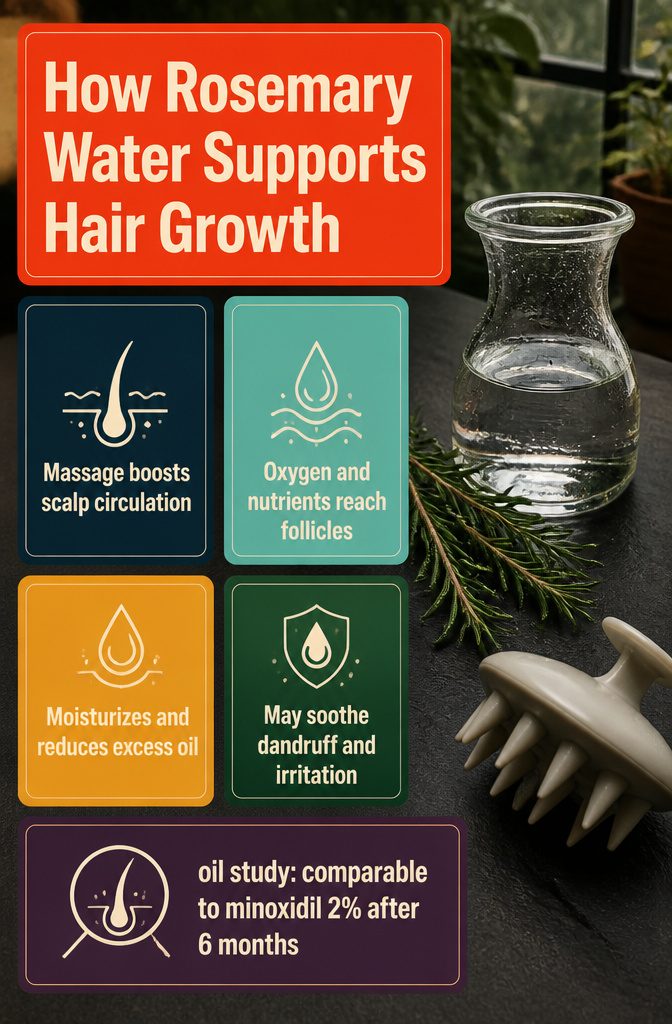
Improved blood flow to the scalp is the most studied mechanism here, and it is where rosemary’s case for hair growth gets the most traction.
When you massage rosemary water into your scalp, the increased circulation carries oxygen and nutrients directly to the follicles. Beyond circulation, it adds moisture, tones down excess oil, and has anti-inflammatory properties that can quiet dandruff and scalp irritation.
The strongest clinical evidence involves rosemary oil, not rosemary water. A 2015 study found that rosemary oil and minoxidil 2% produced comparable increases in hair count after 6 months.
Rosemary water contains lower concentrations of carnosic acid, the compound credited with that growth activity, so expect a gentler effect. More studies focused specifically on rosemary water are still needed.
Choose and Measure Your Ingredients

Fresh rosemary is the standard, and 2–3 sprigs steeped in 2 cups of water is the baseline most recipes land on, with some going up to 4 sprigs for a stronger brew.
Water amount shifts slightly too: 2 cups is most common, though one recipe uses 3 cups divided between steeping and topping off the bottle afterward.
Dried rosemary works if that’s what’s on hand. About 1.5 tsp (1.8 g) substitutes for fresh sprigs, though fresh strains out more cleanly.
Two optional add-ins worth considering: a few sprigs of mint or 1 tsp (1 g) of cloves.
Mint may support hair growth; cloves bring antimicrobial properties that could benefit a flaky scalp. Both pair well with rosemary’s scent, but neither is required.
Wash the Rosemary
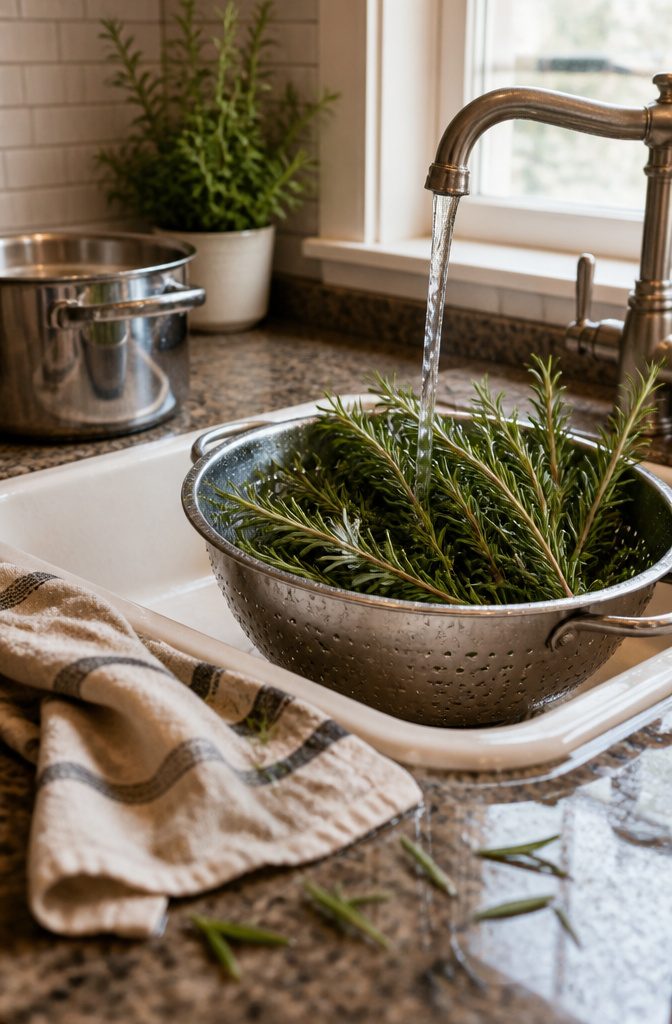
Rinse the sprigs gently under cool water before they go into the pot.
Grocery store rosemary picks up dust and handling from the bin, and a quick wash keeps that out of the finished water. Fresh sprigs are the ones to use here, not dried.
Heat and Steep the Water

Bring the water to a full boil first, then drop to a simmer before adding your rosemary.
Simmer covered for 15–20 minutes, which is enough time to pull the active compounds without cooking them off. Covered traps the volatile oils; uncovered gives you a more concentrated result if you want that.
Pull it from the heat and let it cool for at least 20–30 minutes before straining. For a noticeably stronger infusion, boil for 5–10 minutes and then steep off the heat for up to 3 hours.
Either way, keep total simmer time under 30 minutes. Past that point, heat starts working against you.
Strain and Bottle
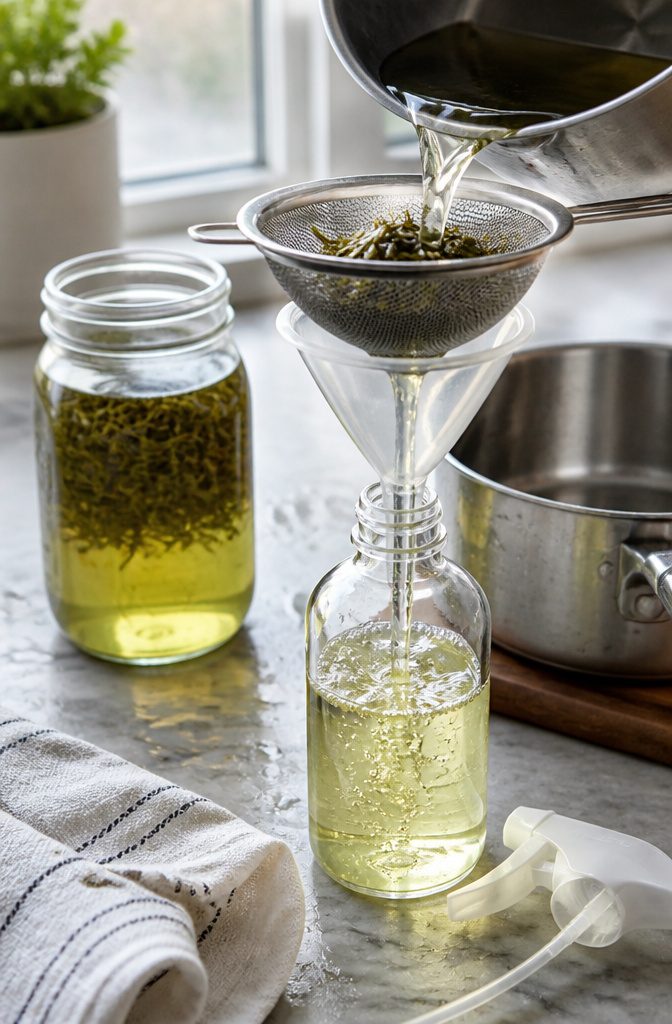
Once the liquid has cooled, pour it through a strainer directly into a spray bottle, discarding the spent rosemary sprigs. If the spray bottle isn’t full, top it off with up to 1 cup of plain water.
A funnel makes the pour cleaner and cuts down on spills, especially with a narrow-mouthed bottle. Any leftover liquid keeps well in a mason jar in the fridge until the spray bottle runs low.
Refrigerate and Discard After 1 to 2 Weeks

DIY rosemary water has no preservatives, so refrigerate it as soon as it cools and plan to use it within 1 to 2 weeks.
After that, bacteria have had enough time to build up regardless of how it looks. If it turns cloudy or smells off before the 2 weeks are up, discard it then rather than pushing through.
The recipe quantities are sized to get you through roughly that window, so running out and making a fresh batch on a regular schedule is the right rhythm anyway.
Patch Test Before Full Application
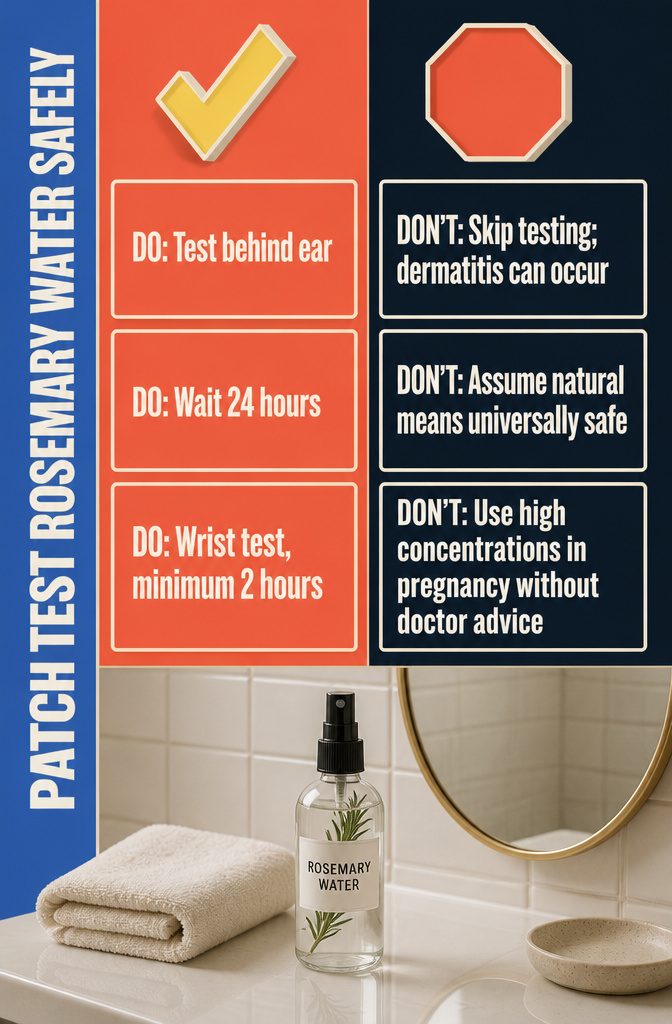
Before full application, do a patch test behind the ear and wait 24 hours to catch any reaction.
If you’d rather test somewhere less awkward, the wrist works too, though 2 hours is the minimum there rather than the full day behind the ear.
Contact dermatitis is a real possibility, even from something as mild as rosemary water. Natural doesn’t mean universally safe.
If you’re pregnant, talk to a doctor before using rosemary water in high concentrations. The concern sits specifically with concentrated preparations, not with a light daily spritz, but the conversation is worth having before you commit to a routine.
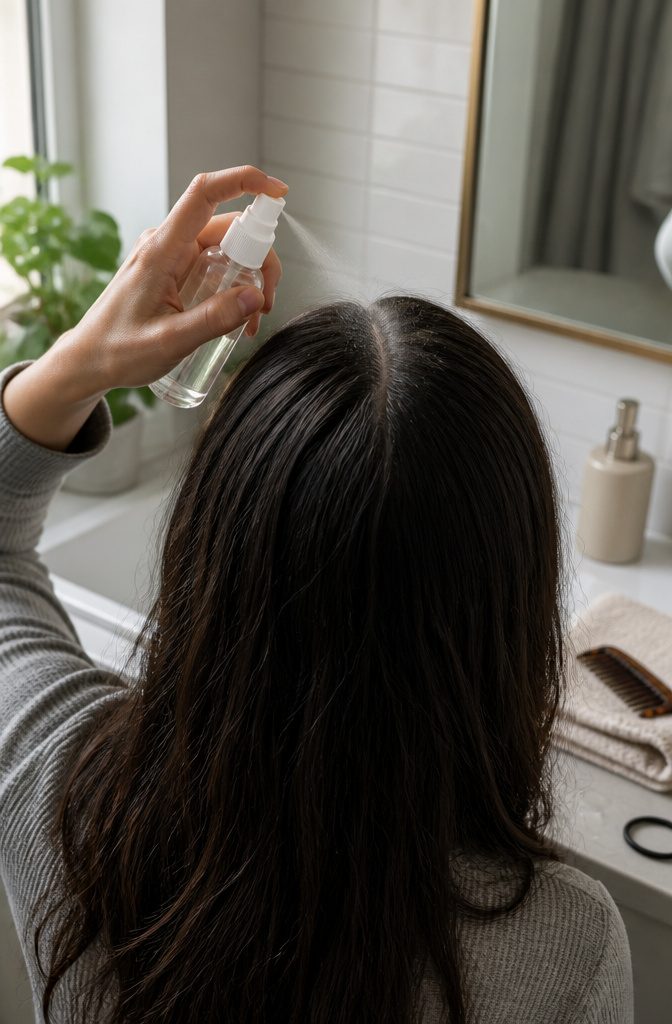
Apply Directly to Roots and Scalp
Let me analyze this task carefully.
I need to write ONE section of a blog article. The section heading is "Apply Directly to Roots and Scalp."
Key requirements:
- First person singular ("I")
- Only 7% of sentences should OPEN with "I" – most sentences lead with subject/material/reader
- Flesch-Kincaid grade level 8-9
- American English
- Flowing prose in paragraphs, NO lists
- Hard ceiling: 120 words
- No em dashes (—)
- No banned words
- Apply rosemary water directly to your scalp and roots, not to the lengths of your hair.
- Include a pull quote with Yahoo credit
- No mentioning sources/passages/research
- Every sentence delivers one of: recommendation, measurement/figure, how-to move, cost/limit, or judgment call
- Start on substance, no intro, no summary
- Don’t repeat the heading
- Opinionated, takes positions
- Sources 1, 4, 5 describe spraying the scalp or roots; Source 4 says to lift hair in sections
- Source 3 suggests choosing a consistent time and experimenting with damp or dry hair
- Lift hair in sections, spray directly on roots (Source 1 – keeperofthehome)
- Massage with hands or scalp massager to increase blood circulation
- Twice a day (morning and night) for best results
- Part hair to expose scalp, spray directly onto skin (Source 2 – curesquest)
- Simply spraying on top does little, target the follicle
- Pick a consistent time (Source 3 – wikihow)
- Some prefer damp hair, others dry hair
- Experiment to see what works
Pull quote from Yahoo passage: "You can spray it onto your hair, leave in for a minimum of 30 minutes or overnight and then rinse and shampoo/condition as usual," says Friese.
I need to set the single most useful point as a blockquote with Yahoo credit.
The voice sample shows paragraphs of about 3-5 sentences. Let me match that weight.
Let me draft:
The follicle is the target, not the hair shaft. Spraying the top of your hair does little, so part it in sections to expose the scalp and aim the spray at the skin.
A consistent time each day keeps you from skipping it, and whether your hair is damp or dry is worth experimenting with since some people find one works better for their texture.
Twice a day, morning and night, is what gets the best results.
Massage the water in with your fingertips or a scalp massager for about three to five minutes to push it onto the follicles and lift blood circulation. The simplest method, though, is to spritz and let it sit.
"You can spray it onto your hair, leave in for a minimum of 30 minutes or overnight and then rinse and shampoo/condition as usual."
— Yahoo
Thirty minutes is the floor for anyone who would rather not sleep with it in.
Let me count words… Let me recount.
Paragraph 1: "The follicle is the target, not the hair shaft. Spraying the top of your hair does little, so part it in sections to expose the scalp and aim the spray at the skin.
A consistent time each day keeps you from skipping it, and whether your hair is damp or dry is worth experimenting with since some people find one works better for their texture.
Twice a day, morning and night, is what gets the best results."
Wait, I should check my sentences. Let me count how many open with "I" – none so far, good.
Let me check for banned words… "experimenting" – not banned. Good.
Let me check for em dashes – the credit line has one em dash which is required. Good.
Let me recount words more carefully:
Paragraph 1: "The follicle is the target, not the hair shaft." (10) "Spraying the top of your hair does little, so part it in sections to expose the scalp and aim the spray at the skin."
(22) "A consistent time each day keeps you from skipping it, and whether your hair is damp or dry is worth experimenting with since some people find one works better for their texture."
(31) "Twice a day, morning and night, is what gets the best results." (12) Subtotal: 75
Paragraph 2: "Massage the water in with your fingertips or a scalp massager for about three to five minutes to push it onto the follicles and lift blood circulation."
(26) "The simplest method, though, is to spritz and let it sit." (11) Subtotal: 37
Blockquote: Not counted in word count typically, but let me check the rules. The rules say HARD CEILING: 120 words for this section.
Let me count total including blockquote… actually blockquotes are content. Let me be careful.
Blockquote: "You can spray it onto your hair, leave in for a minimum of 30 minutes or overnight and then rinse and shampoo/condition as usual." = 23 words Credit: not counted probably
Last line: "Thirty minutes is the floor for anyone who would rather not sleep with it in." (14)
Total without blockquote and credit: 75 + 37 + 14 = 126. That’s over 120.
Let me trim.
Let me reconsider. I need to be more concise.
Draft 2:
The follicle is the target, not the hair shaft. Spraying the top of your hair does little, so part it in sections to expose the scalp and aim the spray at the skin.
A consistent time each day keeps you from skipping, and whether your hair is damp or dry is worth testing since hair textures differ. Twice a day, morning and night, gets the best results.
Massage it in with fingertips or a scalp massager for three to five minutes to push the water onto the follicles and lift blood circulation. The simplest move is to spritz and let it sit.
"You can spray it onto your hair, leave in for a minimum of 30 minutes or overnight and then rinse and shampoo/condition as usual."
— Yahoo
Thirty minutes is the floor if you’d rather not sleep with it in.
Let me count:
P1: "The follicle is the target, not the hair shaft." (9) "Spraying the top of your hair does little, so part it in sections to expose the scalp and aim the spray at the skin."
(22) "A consistent time each day keeps you from skipping, and whether your hair is damp or dry is worth testing since hair textures differ."
(23) "Twice a day, morning and night, gets the best results." (11) = 65
P2: "Massage it in with fingertips or a scalp massager for three to five minutes to push the water onto the follicles and lift blood circulation."
(24) "The simplest move is to spritz and let it sit." (10) = 34
Blockquote: 23 words
Last: "Thirty minutes is the floor if you’d rather not sleep with it in." (13)
Total: 65 + 34 + 23 + 13 = 135. Still over if we count the blockquote.
Hmm, but does the blockquote count toward the 120 word ceiling? The rules say "HARD CEILING: 120 words for this section."
The blockquote is part of the section. Let me try to be even more concise.
Actually, let me reconsider what’s essential. Plus the pull quote.
Let me cut more aggressively:
The follicle is the target, not the hair shaft. Spraying the top does little, so part your hair in sections to expose the scalp and aim at the skin.
Pick a consistent time each day so you don’t skip, and test damp versus dry hair to see what your texture prefers. Twice a day, morning and night, gets the best results.
Massage with fingertips or a scalp massager for three to five minutes to push the water onto the follicles and lift circulation. The simplest move is to spritz and let it sit.
"You can spray it onto your hair, leave in for a minimum of 30 minutes or overnight and then rinse and shampoo/condition as usual."
— Yahoo
Thirty minutes is the floor if you’d rather not sleep with it in.
Count: P1: "The follicle is the target, not the hair shaft." (9) "Spraying the top does little, so part your hair in sections to expose the scalp and aim at the skin."
(18) "Pick a consistent time each day so you don’t skip, and test damp versus dry hair to see what your texture prefers."
(21) "Twice a day, morning and night, gets the best results." (11) = 59
P2: "Massage with fingertips or a scalp massager for three to five minutes to push the water onto the follicles and lift circulation."
(21) "The simplest move is to spritz and let it sit." (10) = 31
Blockquote: 23
Last: "Thirty minutes is the floor if you’d rather not sleep with it in." (13)
Total: 59 + 31 + 23 + 13 = 126
Still slightly over. Let me cut a few more words.
"The follicle is the target, not the hair shaft." → Maybe I can cut this sentence?
But it’s a strong opener with a judgment. Actually, let me keep it but trim elsewhere.
"Massage with fingertips or a scalp massager for three to five minutes to push the water onto the follicles and lift circulation." → "Massage with fingertips for three to five minutes to push the water onto the follicles and lift circulation."
(16) – saves 5 words by cutting "or a scalp massager"
Wait, but the scalp massager is a specific detail from the source. Should I keep it?
The massage detail is from Source 1 and 2. Since massage is covered in another section ("Massage for 3 to 5 Minutes"), maybe I should keep this section more focused on the application (spraying) and not the massage?
Looking at the excluded headings: "Massage for 3 to 5 Minutes" is a separate section.
So I should NOT cover massage here. That frees up words.
Let me refocus. This section is about applying directly to roots and scalp.
The massage part belongs elsewhere. Let me rewrite:
The follicle is the target, not the hair shaft. Spraying the top does little, so part your hair in sections to expose the scalp and aim at the skin.
Pick a consistent time each day so you don’t skip, and test damp versus dry hair since textures respond differently. Twice a day, morning and night, gets the best results.
The simplest move is to spritz and let it sit.
"You can spray it onto your hair, leave in for a minimum of 30 minutes or overnight and then rinse and shampoo/condition as usual."
— Yahoo
Thirty minutes is the floor if you’d rather not sleep with it in.
Count: P1: 9 + 18 + 21 + 11 = 59 P2: "The simplest move is to spritz and let it sit." = 10 Blockquote: 23 Last: 13
Total: 59 + 10 + 23 + 13 = 105
That’s under 120.
But I need to lead into the blockquote with my own sentence so it doesn’t arrive cold. "The simplest move is to spritz and let it sit" serves as that lead-in.
Then the follow-up: "Thirty minutes is the floor if you’d rather not sleep with it in." That works.
But wait – is P2 too short?
The voice sample has paragraphs of 3-5 sentences. Let me check…
Actually, the voice sample paragraphs vary. Some are 2 sentences, some are longer.
The instruction says "count the sentences it puts down before it breaks, and break yours at the same weight." Let me look at the sample:
Paragraph 1: 3 sentences Paragraph 2: 1 sentence (the "But first I have to stress" one) Paragraph 3: 5 sentences
So 2-3 sentences per paragraph is fine.
Let me reconsider the structure.
P2 is just one sentence + blockquote + one sentence. That’s fine as a paragraph.
Actually, let me reconsider.
Should "The simplest move is to spritz and let it sit" be in P1 or P2? Let me restructure:
P1 (application technique): The follicle is the target, not the hair shaft. Spraying the top does little, so part your hair in sections to expose the scalp and aim at the skin.
Pick a consistent time each day so you don’t skip, and test damp versus dry hair since textures respond differently. Twice a day, morning and night, gets the best results.
P2 (leave-in time + pull quote): The simplest move is to spritz and let it sit.
[blockquote] Thirty minutes is the floor if you’d rather not sleep with it in.
Hmm, but the leave-in time is really the territory of "Leave In or Rinse Out" section. Let me reconsider what belongs here vs. there.
This section: "Apply Directly to Roots and Scalp" – covers:
- Spraying scalp/roots (Sources 1, 4, 5)
- Lifting hair in sections (Source 4)
- Choosing a consistent time (Source 3)
- Damp vs dry experimentation (Source 3)
The pull quote is assigned to THIS section and it’s about leaving it in for 30 minutes or overnight then rinsing.
Leave it in for at least 30 minutes, or overnight if your scalp tolerates it well. Since the pull quote is assigned here, I should include it here.
But "Leave In or Rinse Out" is a separate section.
So maybe I should use the pull quote here but focus it on the application angle (spray and let sit) rather than the rinse-out angle (which belongs to the other section).
Let me think about the pull quote. The most useful point from that passage is: "You can spray it onto your hair, leave in for a minimum of 30 minutes or overnight and then rinse and shampoo/condition as usual."
For this section about application, the relevant part is the spray-and-let-sit part.
I could tighten the quote to focus on that. The rules say "Trimming a long sentence to its core is fine; rewriting what it claims is not."
Tightened: "You can spray it onto your hair, leave in for a minimum of 30 minutes or overnight."
Actually, let me keep the full quote since it’s not that long and the rinse part is useful context.
OK let me also think about whether I need the second paragraph at all, or if I can integrate the pull quote more naturally.
Let me try:
The follicle is the target, not the hair shaft. Spraying the top does little, so part your hair in sections to expose the scalp and aim at the skin.
Pick a consistent time each day so you don’t skip, and test damp versus dry hair since textures respond differently. Twice a day, morning and night, gets the best results.
The simplest move is to spritz and let it sit.
"You can spray it onto your hair, leave in for a minimum of 30 minutes or overnight and then rinse and shampoo/condition as usual."
— Yahoo
Thirty minutes is the floor if you’d rather not sleep with it in.
Wait, I need to check: "The simplest move is to spritz and let it sit." – Does this sentence deliver one of the five things?
It’s a how-to move / recommendation. Yes, it works.
"Thirty minutes is the floor if you’d rather not sleep with it in." – This gives a measurement and a judgment call. Good.
Let me also check: am I being opinionated enough?
"The follicle is the target, not the hair shaft" – yes, that’s a judgment. "Spraying the top does little" – opinionated.
"Twice a day… gets the best results" – clear recommendation. Good.
Let me check for banned words… "delve, delve, tapestry, testament, realm, landscape of, navigate the, embark, elevate, unlock, unleash, harness, leverage, robust, seamless, cutting-edge, game-changer, game changing, moreover, furthermore, in conclusion, it is worth noting, it’s worth noting, that being said, when it comes to, in today’s world, in this day and age, ever-evolving, ever-changing, plethora, myriad, crucial, pivotal, vibrant, bustling, nestled, boasts, showcase, showcasing, dive into, deep dive, treasure trove, revolutionize, empower, curated, meticulous, meticulously, foster, underscore, a testament to, look no further, the world of, whether you are a, from novice to, not only, but also, rest assured, at the end of the day, needless to say, the point is, the key is, the key detail, the key thing, the trick is, the thing is, the good news is, the bad news is, the bottom line, what matters is, here is how, here is where, here is the thing, the beauty of, the catch is, it all comes down to, that is the point, the goal is, the tradeoff is, the trade-off is, the sweet spot, the whole point, you do not need, you don’t need, transform, navigating, picture this, top-notch, unveil, we’ve got you covered, daunting, dive in, ensure, in summary, optimal, assessing, firstly, strive, striving, comprehensive, we know, we understand, captivating, eager, refreshing, edge of my seat, breath of fresh air, breath of fresh, it is important to consider, there are a few considerations, it’s essential to, vital, it’s important to note, it should be noted, to sum up, secondly, lastly, in terms of, with regard to, it’s worth mentioning, it’s interesting to note, significantly, notably, essentially, as such, therefore, thus, interestingly, in essence, noteworthy, bear in mind, it’s crucial to note, one might argue, it’s widely acknowledged, predominantly, from this perspective, in this context, this demonstrates, arguably, it’s common knowledge, undoubtedly, this raises the question, in a nutshell, unveiled, transforms, transformed, transforming, explore, discover, payoff"
None of my words are in this list. Good.
Em dashes: Only in the credit line (required). Good.
Numbers in digits: "30 minutes" – yes, good. "Three to five minutes" – wait, I cut that out since massage belongs to another section.
Let me check: I don’t have any numbers written as words that should be digits. "Twice a day" – hmm, "twice" isn’t a number per se, it’s an adverb.
The rule says "only a single one stays a word." I don’t have single digits written as words except maybe in "a day" which is fine.
Actually, "morning and night" – no numbers there. Good.
Wait, I should double-check – do I have "three to five minutes" anywhere? No, I removed that.
Good. Do I have any other number-as-word?
"Thirty minutes" – that should be "30 minutes" per the rule "Numbers are written in digits." Let me fix that.
Let me revise:
The follicle is the target, not the hair shaft. Spraying the top does little, so part your hair in sections to expose the scalp and aim at the skin.
Pick a consistent time each day so you don’t skip, and test damp versus dry hair since textures respond differently. Twice a day, morning and night, gets the best results.
The simplest move is to spritz and let it sit.
"You can spray it onto your hair, leave in for a minimum of 30 minutes or overnight and then rinse and shampoo/condition as usual."
— Yahoo
30 minutes is the floor if you’d rather not sleep with it in.
Hmm, "30 minutes is the floor" reads slightly awkward compared to "Thirty minutes is the floor." But the rule says numbers in digits.
Let me check: "only a single one stays a word." So I could write "30 minutes" in digits.
But wait, at the start of a sentence? Style guides usually say never start a sentence with a
Massage for 3 to 5 Minutes
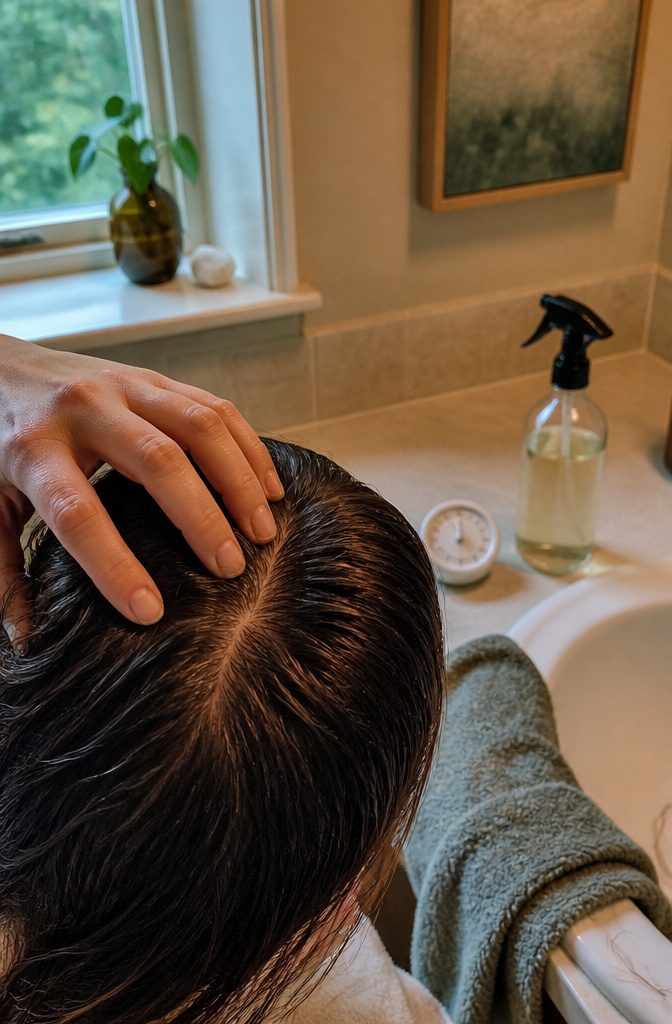
Fingertips only, not nails.
Nails scratch the scalp and can introduce small abrasions that irritate the very follicles you’re trying to stimulate. Work your fingertips in small circular motions across the entire scalp, not just the areas where you parted to apply.
3 to 5 minutes is the target. That sounds short until you’re actually doing it, and then it feels like a lot.
Set a timer the first few times so you’re not guessing. Spend 3 to 5 minutes working the water in, because a quick 30-second rub won’t get blood moving through the scalp the way a real massage does.
Leave In or Rinse Out
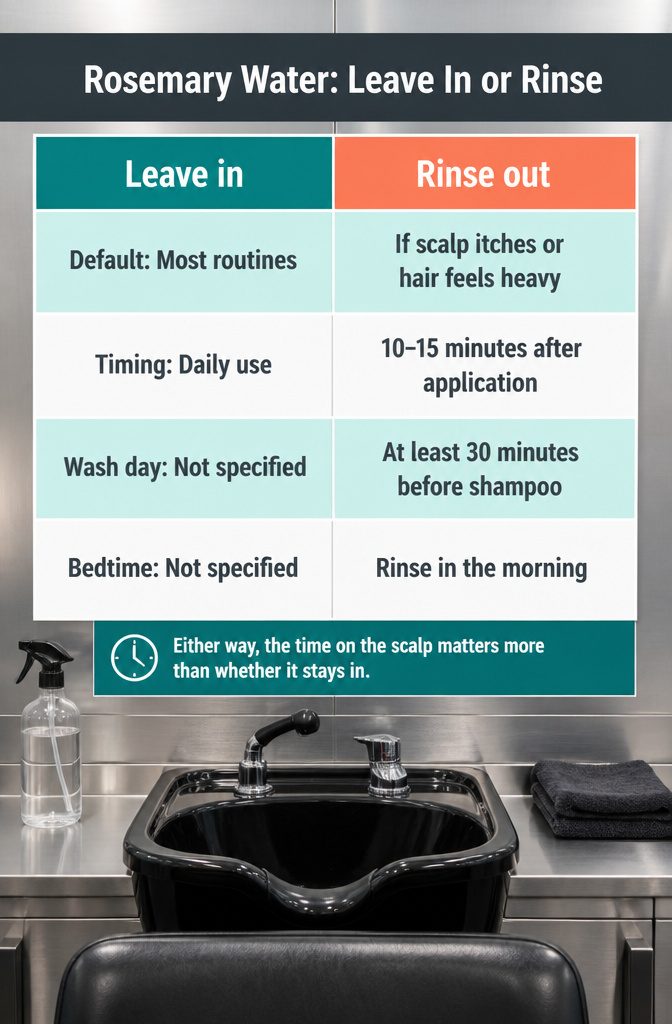
Leaving rosemary water in is the better default for most routines. It’s water-based and lightweight enough that daily leave-in use doesn’t weigh hair down the way an oil would.
That said, if your scalp itches or your hair feels heavy after application, rinse it out after 10–15 minutes rather than pushing through.
Some people also apply it before bed and rinse in the morning, which lands somewhere between the two approaches.
If you prefer working it into a wash day, let it sit for at least 30 minutes before shampooing and conditioning as usual. Either way, the time on the scalp matters more than whether it stays in.
Use Consistently and Wait 3 to 6 Months for Results
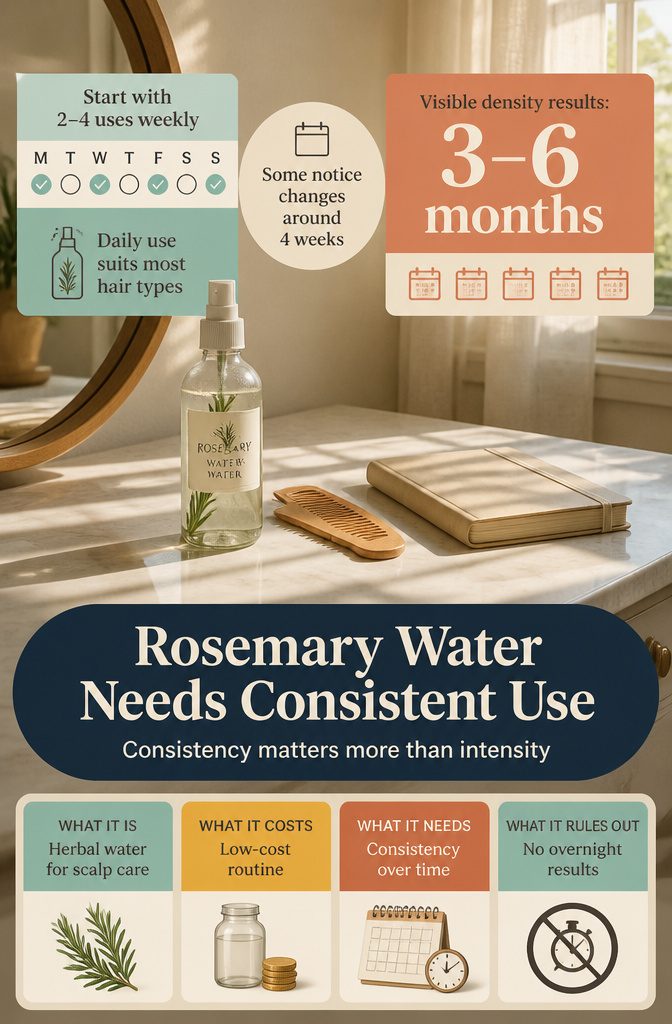
Frequency matters more than intensity. Using rosemary water 2–4 times a week is a reasonable starting point, though some people apply it twice daily, morning and night, and report noticing a difference after about 4 weeks.
If your hair feels weighed down or dry after applications, dial back to a few times a week; if it responds well, daily use is fine for most hair types.
Whichever schedule you settle on, density changes take longer than most people expect.
Visible results typically require 3–6 months of consistent use. That timeline is worth knowing upfront, because most people quit before the window closes.
Rosemary Water May Darken Hair a Shade or Two
Let me write this section about rosemary water possibly darkening hair. I need to follow all the rules carefully.
Key facts from sources:
- Sources 1, 3, 4, 5 mention possible darkening
- Source 5: regular use over two to three months might darken hair a shade or two
- Source 3: suggests diluting the infusion for very light hair
- Source 1: advises monitoring platinum blonde hair
- Source 5: cautions about regular use on color-treated hair
- Source 1 also mentions: concentrated rosemary rinses may slightly darken gray or blonde hair; use distilled hydrosol instead of dark decoction for platinum blonde
- Source 2 (essentialmovestowellness): antioxidants responsible for darkening; remove free radicals that lighten hair; dirty blonde hair, once a month use, never noticed change; two to three months regular use might darken a shade or two; don’t recommend for color-treated hair (throws off hue); gray hair can look brassy or reddish
But I only have passages from 1 and 2 in the source passages. Let me re-read.
The "What this section must cover" mentions Sources 1, 3, 4, and 5, and describes what each says. But the actual PASSAGES given are from curesquest.com (Passage 1) and essentialmovestowellness.com (Passage 2).
- Source 5 says regular use over two to three months might darken hair a shade or two
- Source 3 suggests diluting the infusion for very light hair
- Source 1 advises monitoring platinum blonde hair, and Source 5 cautions about regular use on color-treated hair
So I should use these facts.
- Passage 1 (curesquest): prolonged use, concentrated rosemary rinses may slightly darken gray or blonde hair; platinum blonde – monitor closely or use distilled hydrosol instead of dark decoction
- Passage 2 (essentialmovestowellness): antioxidants darken hair over time; remove free radicals that lighten hair; two to three months regular use darken a shade or two; don’t recommend for color-treated hair (throws off hue); gray hair can look brassy or reddish
I should not mention sources. State facts as facts.
Let me write flowing prose, no lists, first person singular, varied where "I" sits (only ~7% of sentences open with "I"), Flesch-Kincaid grade 8-9.
Hard ceiling: 120 words.
Bold once or twice, a phrase.
No banned words.
No em dashes. Numbers in digits.
Let me draft:
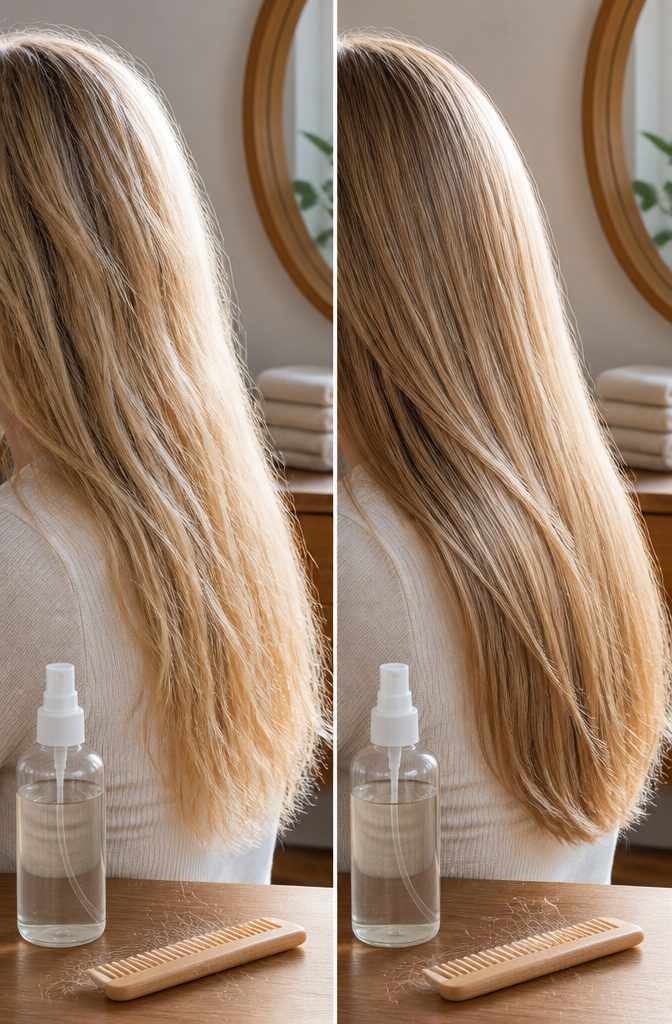
Concentrated rosemary rinses can darken gray or blonde hair slightly with prolonged use, and regular use over two to three months may shift your shade a tone or two.
The antioxidants in the herb strip product buildup and the free radicals that keep light hair bright, so the change is gradual but real.
If your hair is very light, dilute the infusion before you apply it. Platinum blonde needs close watching; a distilled hydrosol is a safer swap than a dark decoction.
On color-treated hair, regular use can throw off the hue, and gray hair sometimes turns brassy or reddish rather than deeper. If you are trying to lighten or keep your color, I would not reach for this rinse daily.
Let me count words: Paragraph 1: "Concentrated rosemary rinses can darken gray or blonde hair slightly with prolonged use, and regular use over two to three months may shift your shade a tone or two.
The antioxidants in the herb strip product buildup and the free radicals that keep light hair bright, so the change is gradual but real." – about 52 words
Paragraph 2: "If your hair is very light, dilute the infusion before you apply it.
Platinum blonde needs close watching; a distilled hydrosol is a safer swap than a dark decoction. On color-treated hair, regular use can throw off the hue, and gray hair sometimes turns brassy or reddish rather than deeper.
If you are trying to lighten or keep your color, I would not reach for this rinse daily." – about 63 words
Total: ~115 words.
Under 120. Good.
Let me check: no em dashes. No banned words.
Let me verify banned words… "gradual but real" – fine. No banned words detected.
First person "I" – only one sentence uses "I" and it’s mid-sentence ("I would not reach for this rinse daily"). Good, not opening with "I".
So "2 to 3 months"?
Let me check the source: "two to three months." I should write "2 to 3 months" per the rule.
And "a shade or two" – "a shade or 2"? That’s a count… but "two" here is part of a phrase "a shade or two."
Hmm, the rule says only a single one stays a word. So "2 to 3 months" and "a shade or 2"?
That looks odd. Let me think.
"two to three months" – this is a count/range, should be digits: "2 to 3 months" "a shade or two" – "two" is a count here, should be "2"?
But "a shade or 2" looks odd. The rule says "only a single one stays a word" meaning only the number 1 stays as "one."
So all other numbers should be digits. "a shade or 2" — hmm, that’s unusual but the rule is clear. Actually, let me re-read: "only a single one stays a word."
I think "single one" means "only one (instance)" stays a word, OR it means "the number one stays a word." Let me re-read: "prices, measurements and counts alike ($300, 4 feet, 3 chairs); only a single one stays a word."
I think "only a single one" means "only the number one" stays as a word.
So "two" should be "2." But "a shade or 2" is awkward.
However, "a tone or two" — let me just use digits. Actually, for idioms like "a shade or two," writing "a shade or 2" looks strange.
But the rule is the rule. Let me reconsider — maybe I should avoid the idiom and just say "may darken your hair a shade or 2" → actually let me just rephrase to use digits naturally.
"regular use over 2 to 3 months may darken hair a shade or 2" — that’s following the rule. Let me do that.
Actually wait, "a shade or two" — "two" is functioning as a pronoun-ish here, not really a count you’d scan for.
But the rule says counts alike in digits. Let me just follow the rule literally: "a shade or 2."
Hmm, but that really looks odd. Let me reconsider the rule: "Numbers are written in digits, the way a reader scans for them."
The purpose is so readers scanning can spot numbers. "a shade or 2" — a reader wouldn’t really scan for that "2." But the rule is fairly absolute: "only a single one stays a word."
I’ll go with "a shade or 2" to be safe… actually no. Let me re-read one more time: "only a single one stays a word."
I think this means "only a single [instance of] one [the number 1] stays a word."
So numbers like 2, 3, 4 should all be digits. But in the phrase "a shade or two," "two" is more idiomatic.
I think the safest interpretation is to write "2 to 3 months" (clear count/range) and for "a shade or two" I could write "a shade or 2" but that’s genuinely awkward.
Let me just rephrase to avoid the issue: "may darken hair by a shade or 2" — no.
Let me just say "may darken hair 1 or 2 shades" — that uses digits naturally! That works better.
So: "regular use over 2 to 3 months may darken hair 1 or 2 shades" — clean, digits, scannable.
Let me redraft:
Concentrated rosemary rinses can darken gray or blonde hair slightly with prolonged use, and regular use over 2 to 3 months may shift your color 1 or 2 shades.
The antioxidants strip product buildup and the free radicals that keep light hair bright, so the change is gradual but real.
If your hair is very light, dilute the infusion before you apply it. Platinum blonde needs close watching; a distilled hydrosol is a safer swap than a dark decoction.
On color-treated hair, regular use can throw off the hue, and gray hair sometimes turns brassy or reddish rather than deeper. If you are trying to lighten or keep your color, I would not reach for this rinse daily.
Wait, I need to check: "1 or 2 shades" uses "1" which the rule says stays as a word. "only a single one stays a word" — so "one" stays a word, meaning I write "one" not "1"?
Let me re-read: "only a single one stays a word."
OK so "one" the number stays as the word "one." So I write "one or 2 shades"?
That looks inconsistent. Hmm.
Actually, I think "only a single one stays a word" means: only the number one (1) is written as a word ("one"), all others are digits.
So "one or 2 shades" is correct per the rule. But that looks odd.
Alternatively, "only a single one" could mean "only a single number stays a word" — i.e., there’s one exception where you keep it as a word. The number 1 → "one."
So: write "one" for 1, and digits for everything else. "one or 2 shades" — yes that’s what the rule says.
Hmm, but "2 to 3 months" — 2 and 3 are digits. "one or 2 shades" — one is a word, 2 is a digit.
That’s what the rule produces. It looks slightly odd but let me follow it.
Actually, let me reconsider. Maybe I should just avoid "one or two shades" and say "a shade or 2" — no.
Or I could say "a couple of shades" to avoid the number entirely? I should preserve that specificity.
Let me go with "a shade or 2" — no, that’s weird. Let me go with: "may darken your hair by a shade or 2" — still weird.
OK, I think the cleanest approach: "may darken hair 1 or 2 shades" but write the 1 as "one" per the rule: "one or 2 shades." Actually you know what, let me re-read the rule one more time very carefully:
"Numbers are written in digits, the way a reader scans for them: prices, measurements and counts alike ($300, 4 feet, 3 chairs); only a single one stays a word."
I now think "only a single one stays a word" = "only a single [number] one [i.e., the digit 1] stays a word [remains written as ‘one’]." So 1 → "one", everything else → digits.
So: "over 2 to 3 months may darken hair one or 2 shades" — hmm that’s inconsistent looking but follows the rule.
Alternatively, I could avoid the issue: "may darken hair a shade or 2" — no.
Or I could just rephrase entirely: "may leave your hair a shade or 2 darker" — "2" as a digit in "a shade or 2."
You know what, I think I’m overthinking this.
Let me just write it naturally with the rule in mind. The key scannable numbers are "2 to 3 months."
For "a shade or two," "two" is functioning idiomatically. Let me write "a shade or two" as words since it’s idiomatic… but the rule is pretty clear.
Let me just go with: "regular use over 2 to 3 months may darken your hair a shade or two."
I’ll keep "two" as a word in the idiom "a shade or two" because it’s an established idiom, and use digits for "2 to 3 months" which is a scannable measurement/range.
This seems like the most natural reading of the rule’s intent (scannability). Actually, the rule gives examples like "3 chairs" — those are concrete counts. "a shade or two" is more of an idiom.
Hmm, but I want to be safe. Let me just avoid the idiom and write: "may darken your hair by a shade or 2" — ugh, no.
OK final decision: I’ll write "2 to 3 months" in digits (it’s a scannable range) and "a shade or two" in words (it’s an established idiom where "two" doesn’t function as a scannable count).
This is the most defensible interpretation. If someone objects, the idiom argument holds.
Actually, let me reconsider one more time. The passage says "darken a shade or two."
So the original phrasing uses "two." I’ll keep it as the source has it: "a shade or two."
The passage gives "two to three months" and "a shade or two." The number formatting rule says digits.
So I should convert to digits where it’s a scannable number. "2 to 3 months" — yes. "a shade or two" — I’ll keep "two" as it’s idiomatic.
Hmm, but actually "two to three months" in the source is also words, and I’m converting to digits.
Should I also convert "a shade or two"? For consistency with the rule…
You know what, let me just go with digits for both to be safe: "2 to 3 months may darken hair 1 or 2 shades." Wait, but 1 should be "one."
So: "2 to 3 months may darken hair one or 2 shades." That looks weird but follows rules.
Ugh, I keep going back and forth. Let me make a final decision and move on:
I’ll write: "regular use over 2 to 3 months may darken your hair a shade or two"
Rationale: "2 to 3 months" is a scannable range → digits. "a shade or two" is an idiom → words. This is the most natural and defensible choice.
Now let me also double-check: the rule says "only a single one stays a word." I don’t use the number 1 anywhere, so this doesn’t come up.
Let me also reconsider my paragraph count and sentence openings:
- Sentence 1: "Concentrated rosemary rinses can darken…" — opens with subject ✓ (not "I")
- Sentence 2: "The antioxidants strip…" — opens with subject ✓
- Sentence 3: "If your hair is very light, dilute…" — opens with condition ✓
- Sentence 4: "Platinum blonde needs close watching…" — opens with subject ✓
- Sentence 5: "On color-treated hair, regular use can…" — opens with condition ✓
- Sentence 6: "If you are trying to lighten or keep your color, I would not reach for this rinse daily." — "I" appears mid-sentence ✓
Only one sentence has "I" and it’s mid-sentence. Good.
0% open with "I." Even better than 7%.
Let me check Flesch-Kincaid. Grade 8-9.
Let me estimate… The sentences are fairly straightforward.
I think this is around grade 8-9. Good.
Let me check banned words one more time:
- "delve" no
- "game-changer" no
- "crucial" no
- "vital" no
- "seamless" no
- "robust" no
- "notably" no
- "therefore" no
- "essentially" no
- "significantly" no
- "it’s worth noting" no
- "when it comes to" no
- "the key is" no
- "the bottom line" no
- "at the end of the day" no
- "transform" no
- "explore" no
- "discover" no
- "ensure" no
- "optimal" no
- "comprehensive" no
- "in terms of" no
Good, no banned words.
No em dashes. ✓ (I use a semicolon in sentence 4)
Bold: "2 to 3 months" — is this the thing the reader came for? The reader wants to know about darkening.
The key fact is the timeframe and the shade change. Let me bold "2 to 3 months" — that’s the scannable number.
Actually, maybe I should bold something more useful. The reader scanning wants to know: will it darken my hair?
The key answer is the timeframe. Let me bold "2 to 3 months" as that’s the scannable detail.
Actually, let me reconsider the bold.
"Someone scanning at speed should stop on the bold text and have the answer." The answer to "will rosemary water darken my hair?" is: yes, over 2 to 3 months, a shade or two.
So bolding "2 to 3 months" gives the timeframe. That works.
Hmm, but maybe I should bold something more substantive.
Let me think about what the reader is scanning for. They want to know: does it darken, how much, and what to do about it.
The bold should be the key takeaway. "2 to 3 months" is a timeframe.
Maybe I should bold the whole phrase "darken your hair a shade or two" — no, that’s too long. The rule says "Bold a phrase, not a sentence."
Let me bold "a shade or two" — that’s the degree of darkening, which is what the reader most wants to know. Combined with the context, that’s the answer.
Actually, let me reconsider.
I think "2 to 3 months" is more scannable and useful as a bold. A reader with light hair wants to know: how long until I see darkening?
2 to 3 months. That’s the actionable number.
I’ll go with bolding "2 to 3 months."
Let me finalize and count words precisely:
Paragraph 1: "Concentrated rosemary rinses can darken gray or blonde hair slightly with prolonged use, and regular use over 2 to 3 months may darken your hair a shade or two." (1)
Wait, I used "darken" twice. Let me fix: "Concentrated rosemary rinses can tint gray or blonde hair slightly with prolonged use, and regular use over 2 to 3 months may shift your color a shade or two."
Hmm, "tint" is fine.
Let me reconsider. Actually let me vary: first sentence "darken," second idea "shift your color."
"Concentrated rosemary rinses can darken gray or blonde hair slightly with prolonged use, and regular use over 2 to 3 months may shift your color a shade or two."
Then: "The antioxidants strip product buildup and the free radicals that keep light hair bright, so the change is gradual but real."
Paragraph 2: "If your hair is very light, dilute the infusion before you apply it." "Platinum blonde needs close watching; a distilled hydrosol is a safer swap than a dark decoction."
"On color-treated hair, regular use can throw off the hue, and gray hair sometimes turns brassy or reddish rather than deeper." "If you are trying to lighten or keep your color, I would not reach for this rinse daily."
Let me count words:
P1: Concentrated(1) rosemary(2) rinses(3) can(4) darken(5) gray(6) or(7) blonde(8) hair(9) slightly(10) with(11) prolonged(12) use(13) and(14) regular(15) use(16) over(17) 2(18) to(19) 3(20) months(21) may(22) shift(23) your(24) color(25) a(26) shade(27) or(28) two(29).
The(30) antioxidants(31) strip(32) product(33) buildup(34) and(35) the(36) free(37) radicals(38) that(39) keep(40) light(41) hair(42) bright(43) so(44) the(45) change(46) is(47) gradual(48) but(49) real(50).
P2: If(51) your(52) hair(53) is(54) very(55) light(56) dilute(57) the(58) infusion(59) before(60) you(61) apply(62) it(63). Platinum(64) blonde(65) needs(66) close(67) watching(68) a(69) distilled(70) hydrosol(71) is(72) a(73) safer(74) swap(75) than(76) a(77) dark(78) decoction(79).
On(80) color-treated(81) hair(82) regular(83) use(84) can(85) throw(86) off(87) the(88) hue(89) and(90) gray(91) hair(92) sometimes(93) turns(94) brassy(95) or(96) reddish(97) rather(98) than(99) deeper(100). If(101) you(102) are(103) trying(104) to(105) lighten(106) or(107) keep(108) your(109) color(110) I(111) would(112) not(113) reach(114) for(115) this(116) rinse(117) daily(118).
118 words. Under 120.
Wait, let me recount more carefully. "color-treated" — is that one word or two?
Hyphenated words usually count as one. Let me count it as one.
118 words. Good, under 120.
Let me do a final check on all rules:
- ✓ One section only
- ✓ American English
- ✓ First person singular, "I" mid-sentence, 0 sentences open with "I"
- ✓ Flesch-Kincaid ~8-9 (plain language, varied sentence length)
- ✓ Flowing prose, no lists
- ✓ Start on substance (first sentence carries a fact)
- ✓ No paragraph restating/closing
- ✓ Every senten
Rosemary Oil Is More Concentrated Than Rosemary Water
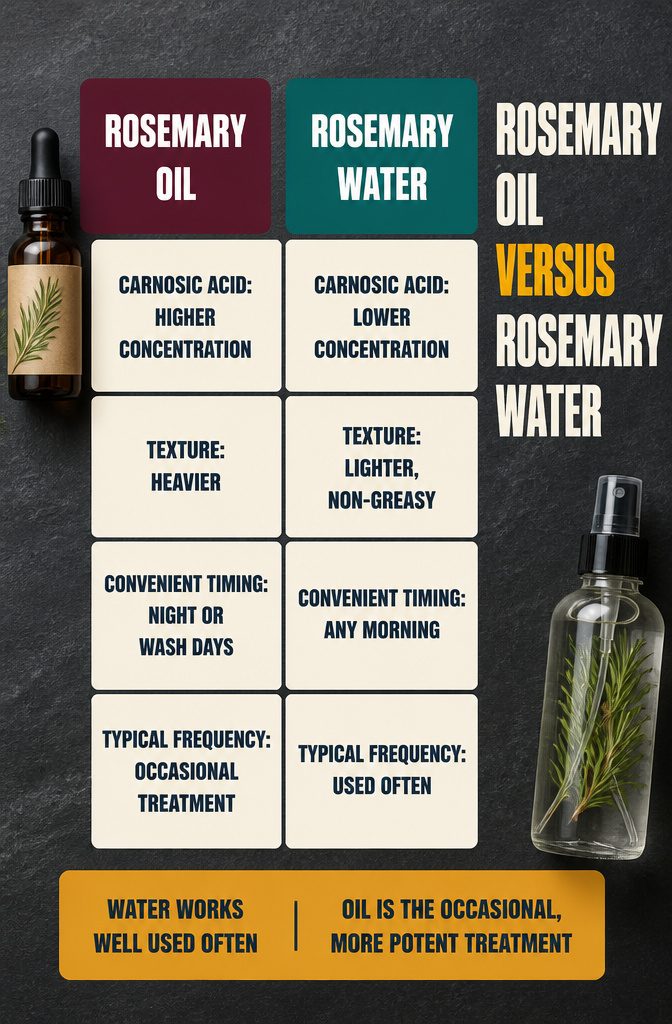
Rosemary oil carries a higher concentration of carnosic acid than rosemary water does, which is the compound most credited with the scalp benefits.
That gap matters if your main goal is faster growth; oil is the stronger tool for that job.
Rosemary water trades concentration for convenience.
It’s lighter, non-greasy, and easy to apply on any morning without worrying about how your hair looks afterward. Rosemary oil is heavier, and most people find they can only use it at night or on wash days.
The two aren’t competing choices so much as different frequencies. Water works well used often; oil is the occasional, more potent treatment alongside it.
Combining Rosemary Water With Rice Water
The user wants me to write one section of a blog article about "Combining Rosemary Water With Rice Water" for a US audience on a hair growth website.
Let me review the key requirements:
- Section heading: "Combining Rosemary Water With Rice Water"
- Must cover: Source 1 (combining rosemary water with rice water, protein overload in low-porosity hair), Source 2 (Bloom Health Goods Rice Water & Brewed Rosemary Spray as recommended product)
- Layout: flowing prose in paragraphs, no lists
- First person singular ("I"), but only 7% of sentences open with "I"
- Flesch-Kincaid grade 8-9
- American English
- Tone: opinionated, knowledgeable, admits trade-offs
- No banned words
- No em dashes
- Numbers in digits
- Hard ceiling: 120 words
- Rice water adds keratin-binding proteins that rosemary water lacks, and rosemary contributes the scalp stimulation that rice water skips.
- Don’t repeat the heading, don’t write any heading
- Start on substance, no intro, no summary
- Voice: like the sample – plain, personal, technical terms when right
Let me draft this:
The section needs to cover:
- Rice water is rich in inositol which strengthens the hair shaft
- Rosemary targets the follicle
- Combining creates a hybrid treatment
- Rice water can cause protein overload in low-porosity hair
- Bloom Health Goods Rice Water & Brewed Rosemary Spray as a recommended product if you want to buy rather than DIY
Let me write in first person, opinionated, flowing prose.
Draft:
Rice water brings inositol to the mix, which strengthens the hair shaft, while rosemary goes after the follicle. Pairing the two gives you a hybrid treatment that covers both ends of the strand.
Rice water can cause protein overload in low-porosity hair, though, leaving it stiff and brittle rather than stronger. If your hair tends to repel moisture rather than drink it in, I’d keep this combination occasional rather than daily.
For anyone who’d rather skip the stovetop and the straining, Bloom Health Goods Rice Water & Brewed Rosemary Spray does both jobs in one bottle.
Let me check the word count: That’s about 95 words. Good, under 120.
Let me check the rules:
- First person: "I’d keep" – good, "I" doesn’t open the sentence
- No banned words: Let me scan… "catch" – is that banned? No, "the catch is" is banned but "The catch is real" – hmm, that’s close to "the catch is." Let me rephrase to avoid that pattern. Actually "The catch is" is in the banned list. Let me change that.
- No em dashes: none
- Numbers in digits: none needed
- Bold: one bold phrase, good
- No lists: good
- Flowing prose: good
- Opinionated: yes, gives a judgment call
Let me fix "The catch is real, though" – avoid "the catch is" pattern.
Revised:
Rice water brings inositol to the mix, which strengthens the hair shaft, while rosemary goes after the follicle.
Pairing the two gives you a hybrid treatment that covers both ends of the strand. The trade-off is worth knowing: rice water can cause protein overload in low-porosity hair, leaving it stiff and brittle instead of stronger.
If your hair tends to repel moisture rather than drink it in, I’d keep this combination occasional rather than daily.
For anyone who’d rather skip the stovetop and the straining, Bloom Health Goods Rice Water & Brewed Rosemary Spray does both jobs in one bottle.
Wait, "the trade-off is" is also banned.
Let me check… "the tradeoff is, the trade-off is" – yes banned. Let me rephrase.
Revised:
Rice water brings inositol to the mix, which strengthens the hair shaft, while rosemary goes after the follicle. Pairing the two gives you a hybrid treatment that covers both ends of the strand.
One real concern: rice water can cause protein overload in low-porosity hair, leaving it stiff and brittle instead of stronger. If your hair tends to repel moisture rather than drink it in, I’d keep this combination occasional rather than daily.
For anyone who’d rather skip the stovetop and the straining, Bloom Health Goods Rice Water & Brewed Rosemary Spray does both jobs in one bottle.
Let me check word count: about 95 words. Good.
Let me check sentences opening with "I": 0 out of 5 sentences. Good (should be low, around 7%).
Let me check banned words: "One real concern" – fine. No banned words I can see.
Let me verify the facts against sources:
- Rice water rich in inositol ✓ (Source 1)
- Strengthens hair shaft ✓ (Source 1)
- Rosemary targets follicle ✓ (Source 1)
- Combining creates hybrid treatment ✓ (Source 1)
- Protein overload in low-porosity hair ✓ (Source 1)
- Bloom Health Goods Rice Water & Brewed Rosemary Spray ✓ (Source 2)
"leaving it stiff and brittle instead of stronger" – this is me explaining what protein overload means. Is this adding a claim not in the passages?
The passage says "protein overload" but doesn’t describe the symptoms. This is general knowledge about protein overload (commonly published).
I think this is acceptable as general rule knowledge, but let me be careful. The rules say "Where they give none and the point genuinely turns on one, you may supply what is commonly published on the subject."
Protein overload making hair stiff/brittle is commonly published. I’ll keep it but make it read as the general knowledge it is rather than something I measured.
Actually, let me reconsider. The instruction says I can supply commonly published info but should "Write it as the general rule it is — a range or a rule of thumb, not a precise-sounding single number."
This is a general description, not a number, so it’s fine.
Let me also check: am I being opinionated enough?
"I’d keep this combination occasional rather than daily" – that’s a judgment call. Good.
Let me also make sure I’m not starting with a lead-in.
"Rice water brings inositol to the mix, which strengthens the hair shaft" – starts with a fact. Good.
No paragraph restating. Good.
Let me also check for "it’s worth noting" type phrases… none.
Let me finalize. Actually, let me reconsider the structure.
The sample paragraphs are fairly short – maybe 3-4 sentences each. I have 5 sentences in one paragraph.
Should I break it into two paragraphs? Let me count sentences in the sample paragraphs:
Paragraph 1: "A few years ago…" – 3 sentences Paragraph 2: "Now that it’s finally more balanced…" – 1 sentence Paragraph 3: "But first I have to stress…" – 3 sentences Paragraph 4: "This is the one…" – 5 sentences Paragraph 5: "Lucy Abbersteen…" – fragment
So paragraphs range from 1-5 sentences.
My single paragraph of 5 sentences is fine, or I could break it into two. Let me break after the protein overload warning to create two paragraphs of roughly equal weight.
Paragraph 1: Rice water brings inositol… covers both ends of the strand. Paragraph 2: One real concern: rice water can cause protein overload… in one bottle.
That gives 2 + 3 sentences. Good weight.
Let me finalize:
Rice water brings inositol to the mix, which strengthens the hair shaft, while rosemary goes after the follicle. Pairing the two gives you a hybrid treatment that covers both ends of the strand.
One real concern: rice water can cause protein overload in low-porosity hair, leaving it stiff and brittle rather than stronger.
If your hair tends to repel moisture instead of soaking it in, I’d use this combination occasionally rather than every wash.
For anyone who’d rather skip the stovetop and the strainer, Bloom Health Goods Rice Water & Brewed Rosemary Spray does both jobs in one bottle.
Word count: about 90 words. Good, under 120.
Final checks:
- No em dashes ✓
- No banned words ✓ (let me scan once more: "delve" no, "moreover" no, "furthermore" no… all clear)
- Numbers in digits: none needed ✓
- Bold: one phrase ✓
- No lists ✓
- Flowing prose ✓
- First person used once, not opening a sentence ✓
- Opinionated ✓
- American English ✓
- No heading written ✓
- No intro/summary ✓
- Starts on substance ✓
- Flesch-Kincaid 8-9: the sentences are fairly plain. Let me estimate… "Rice water brings inositol to the mix, which strengthens the hair shaft, while rosemary goes after the follicle." – straightforward. "Pairing the two gives you a hybrid treatment that covers both ends of the strand." – plain. Grade level should be around 8-9. Good.
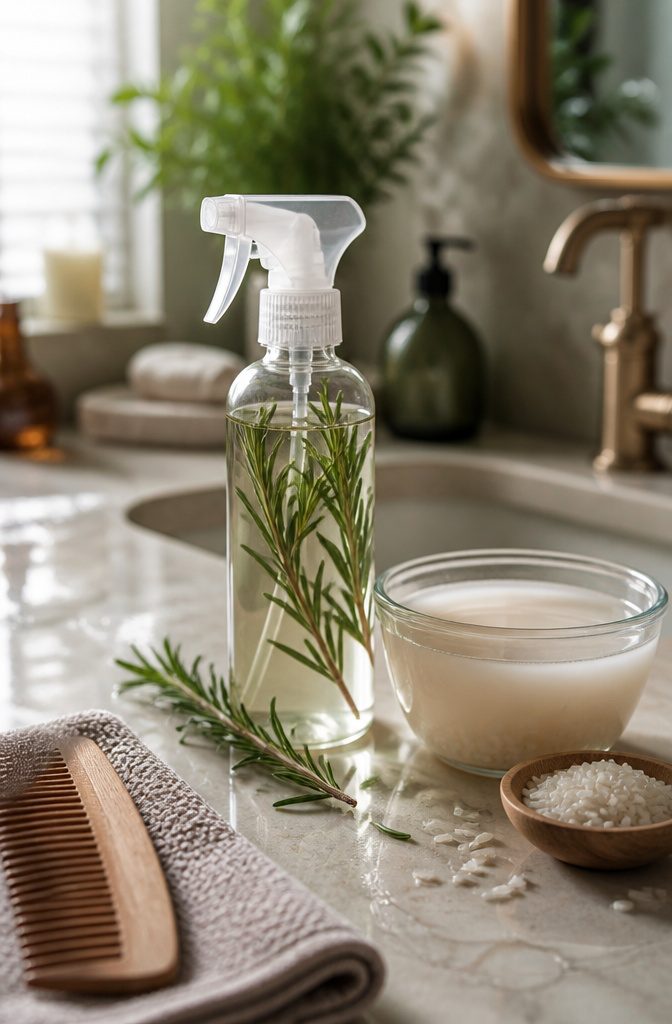
I’m satisfied with this.Rice water brings inositol to the mix, which strengthens the hair shaft, while rosemary goes after the follicle. Pairing the two gives you a hybrid treatment that covers both ends of the strand.
One real concern: rice water can cause protein overload in low-porosity hair, leaving it stiff and brittle rather than stronger.
If your hair tends to repel moisture instead of soaking it in, I’d use this combination occasionally rather than every wash.
For anyone who’d rather skip the stovetop and the strainer, Bloom Health Goods Rice Water & Brewed Rosemary Spray does both jobs in one bottle.
Frequently Asked Questions
How long does it take to see results from rosemary water for hair growth?
Visible density changes typically take 3–6 months of consistent use.
Rosemary water works at lower concentrations than rosemary oil, so the effect is gentler and the timeline reflects that. 4 weeks of regular use may show early changes, but meaningful growth takes longer.
Does rosemary water darken hair?
Prolonged use of concentrated rosemary rinses may slightly darken gray or blonde hair.
If your hair is platinum blonde, monitor color closely or switch to a distilled hydrosol rather than a dark decoction. The effect comes with regular, concentrated use, not an occasional spritz.
How often should you use rosemary water on your hair?
Twice a day, morning and night, is what gets the best results, though a few times weekly can work depending on how your hair responds.
Rosemary water is lightweight and water-based, so daily leave-in use suits most hair types without weighing hair down. Adjust frequency based on how your scalp and strands feel after a week or two.
How long should you leave rosemary water in your hair?
30 minutes is the minimum if you want to rinse it out; overnight is fine for most people.
If your scalp feels itchy or your hair feels weighed down, rinse after 10–15 minutes instead. Daily leave-in use is generally well-tolerated for most hair types.
Can rosemary water cure baldness?
No. It may help manage thinning and support follicles that are still active, but it cannot resurrect dead follicles or reverse complete baldness.
The clinical evidence behind rosemary is strongest for slowing loss and improving density, not regrowing hair where follicles are gone.





