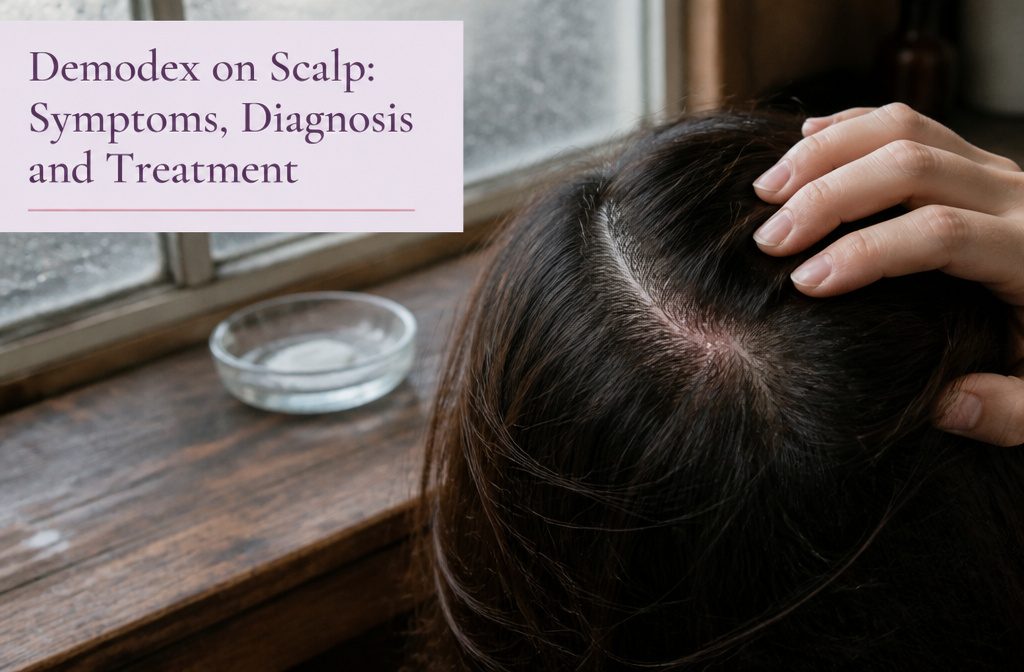
Demodex on the scalp refers to the presence of two species of microscopic mites, Demodex folliculorum and Demodex brevis, that live in hair follicles and oil glands.
Most adults carry them without symptoms, but when density climbs above 5 mites per square centimeter alongside inflammation, they can cause patchy hair loss, redness, scaling and pustules.
In one scalp biopsy study of 333 samples, 17 contained mites but only 4 were judged pathogenic after weighing clinical presentation and treatment response.
What Demodex Mites Are and When They Become a Problem
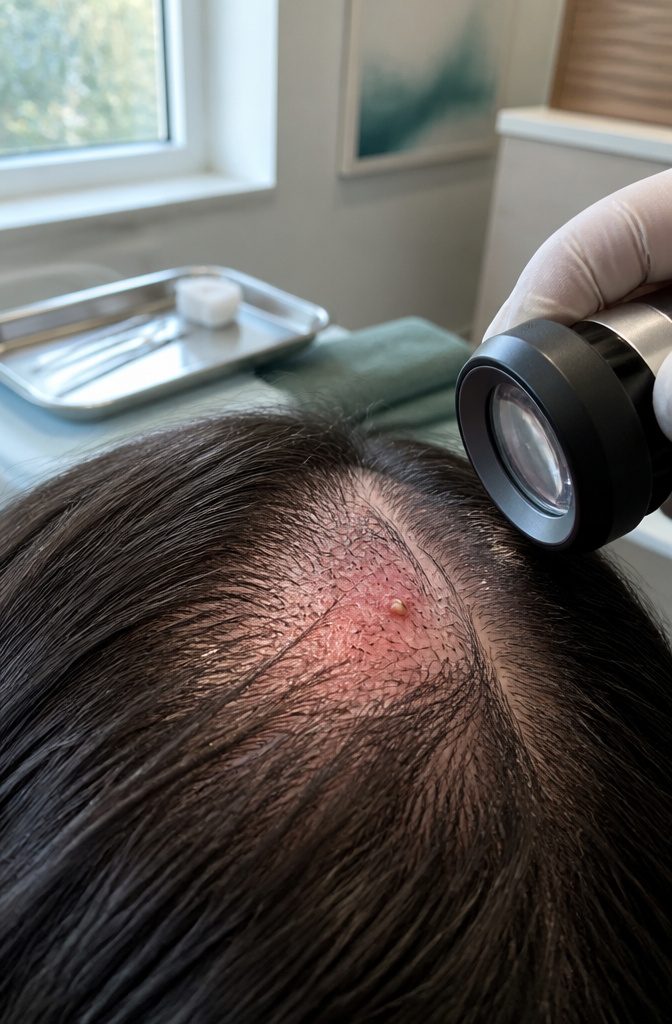
Demodex folliculorum and Demodex brevis live in the hair follicles and oil glands of nearly everyone past childhood.
The first is 0.3–0.4 mm long, the second 0.15–0.2 mm. Both feed on sebum and settle into the pilosebaceous units, D. folliculorum in the upper canal of the follicle and D. brevis deeper in the sebaceous glands.
Finding them during a scalp exam or biopsy does not prove disease. Healthy adults carry them at low density, usually under five mites per square centimeter of skin.
D. brevis does not usually lead to complications, but large numbers of mites (over 5 per square centimeter of skin) may cause demodicosis.
The shift from harmless resident to problem happens when density climbs above that threshold or when mites sit alongside visible inflammation.
A scalp showing hair loss, redness, scales and pustules with mites in multiple follicles and inflammatory cells nearby may point to demodicosis. Presence and symptoms together matter more than presence alone.
Hair Loss, Redness, Scaling and Pustules on the Scalp
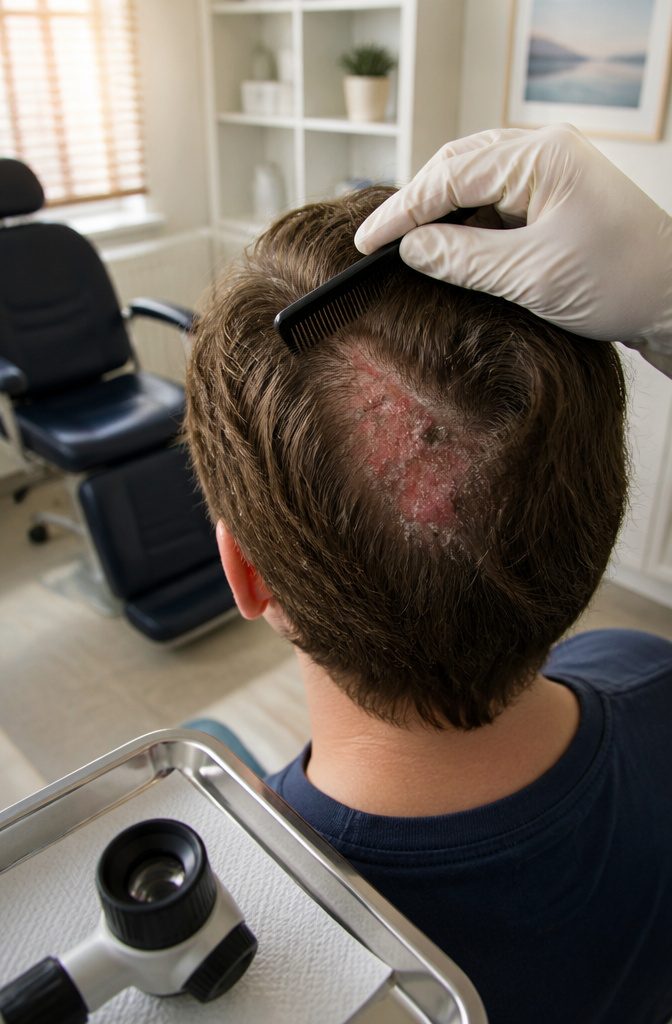
When scalp demodicosis does cause symptoms, the pattern I see described most often in confirmed cases includes patchy hair loss, areas of redness, visible scales, and pustules.
These tend to cluster rather than spread evenly across the entire scalp, though the exact distribution varies from one person to another.
Itching and dandruff-like flaking also show up in many cases, but the four findings that clinicians document most reliably in biopsy-confirmed scalp demodicosis are thinning hair, inflamed red patches, scaling, and small fluid-filled bumps.
None of these symptoms are unique to mites. Scalp psoriasis, seborrheic dermatitis, folliculitis from bacteria or yeast, and even stress-related shedding can all produce overlapping signs.
That overlap is why diagnosis requires more than a visual check, and why treatment aimed at mites often begins only after other common causes have been ruled out or failed to respond.
How Clinicians Confirm Whether Mites Are Causing Symptoms

Diagnosis pairs clinical assessment with lab confirmation. A doctor examining scalp symptoms will take a skin scraping, press a cyanoacrylate-coated slide against the surface to lift part of the stratum corneum and follicle tops, or perform a biopsy.
The collected material goes under a microscope, often after treatment with 10% to 15% potassium hydroxide to clear debris and make mites visible.
The threshold that separates normal carriage from pathogenic density is 5 or more mites in a low-power field or more than 5 mites per square centimeter in standardized biopsy.
Finding mites does not automatically mean they are causing the problem.
One scalp biopsy study turned up Demodex in 17 of 333 samples submitted for hair loss and alopecia, but only 4 cases were judged pathogenic after weighing clinical presentation, histology and treatment response.
In those four, mites appeared in multiple follicles alongside inflammatory cells, and symptoms resolved with metronidazole. The other 13 carried mites without enough inflammation or symptom correlation to implicate them.
Metronidazole Response in Scalp Cases and Broader Treatment Options
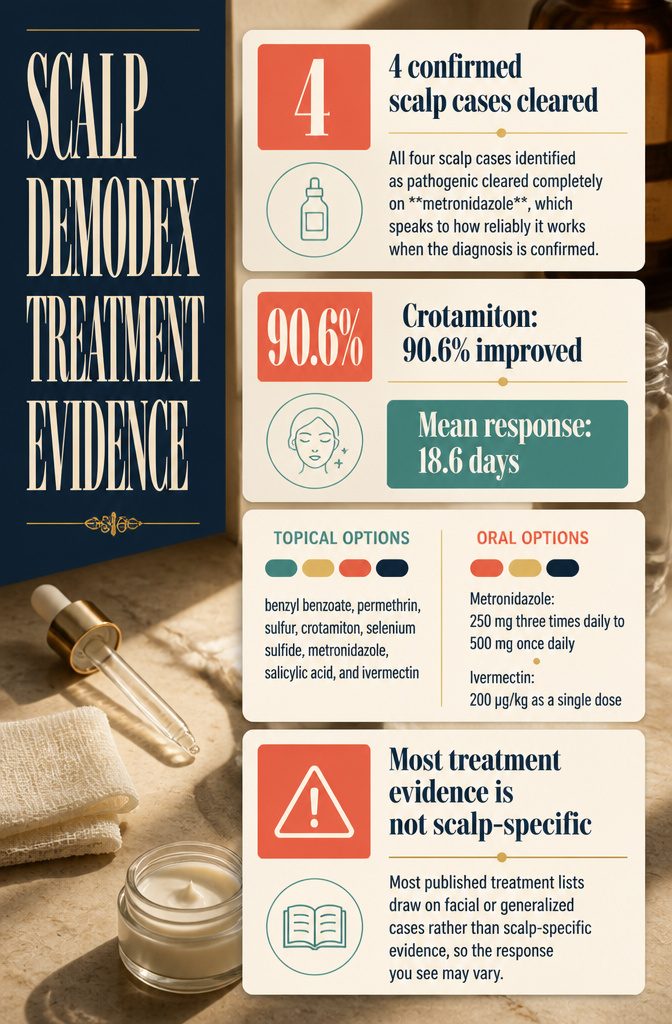
All four scalp cases identified as pathogenic cleared completely on metronidazole, which speaks to how reliably it works when the diagnosis is confirmed.
For broader treatment, topical options include benzyl benzoate, permethrin, sulfur, crotamiton, selenium sulfide, metronidazole, salicylic acid, and ivermectin.
Oral metronidazole runs from 250 mg three times daily to 500 mg once daily, and ivermectin is dosed at 200 µg/kg as a single dose.
One facial study of 63 patients using crotamiton found that 90.6 percent experienced at least 50 percent improvement at a mean 18.6 days. Most published treatment lists draw on facial or generalized cases rather than scalp-specific evidence, so the response you see may vary.
Why Presence Alone Does Not Mean Disease

Finding Demodex on the scalp does not automatically mean it is causing a problem. These mites live on skin as normal residents, and a scalp biopsy study looking at 333 specimens found mites in just over 5 percent of cases.
Of those 17 mite-positive biopsies, 13 were judged nonpathogenic based on clinical presentation, tissue appearance, and treatment response. The mites were there, but they were not driving disease.
That distinction matters because diagnosis depends on both mite presence and compatible inflammation or symptoms. Many scalp conditions present with redness, scaling, pustules, or hair loss, and several can mimic demodicosis.
Context separates a neutral finding from a pathogenic one: tissue infiltrated by inflammatory cells around multiple follicles containing mites, symptoms that align, and response to anti-Demodex therapy all point toward actual disease rather than incidental colonization.
Pathogenic Scalp Cases Showed Mites in Multiple Follicles and Inflammatory Cells
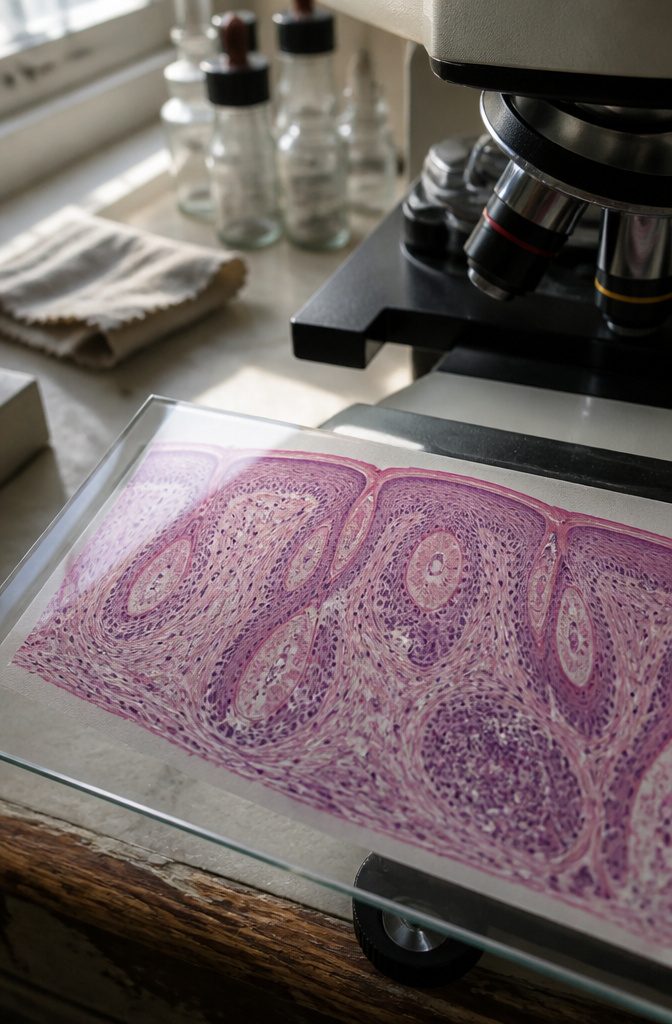
In the four cases where clinicians decided mites were causing scalp symptoms, biopsies showed Demodex in at least two follicles per tissue sample, not just a single stray organism.
The follicles themselves carried signs of inflammation: immune cells clustered around or inside the structures, and in some samples pathologists identified granulomas, which are organized lumps of inflammatory tissue that form in response to a foreign body or persistent irritant.
That combination of multiple colonized follicles and active inflammation marked these cases as pathogenic.
The thirteen nonpathogenic cases looked different. Mites were present in those biopsies too, but the follicles lacked the inflammatory response and the mites appeared in smaller numbers or isolated locations.
The tissue read as tolerating the mites rather than reacting to them, which matched the absence of clinical symptoms in those patients.
Conditions That May Raise Mite Levels or Risk of Symptoms
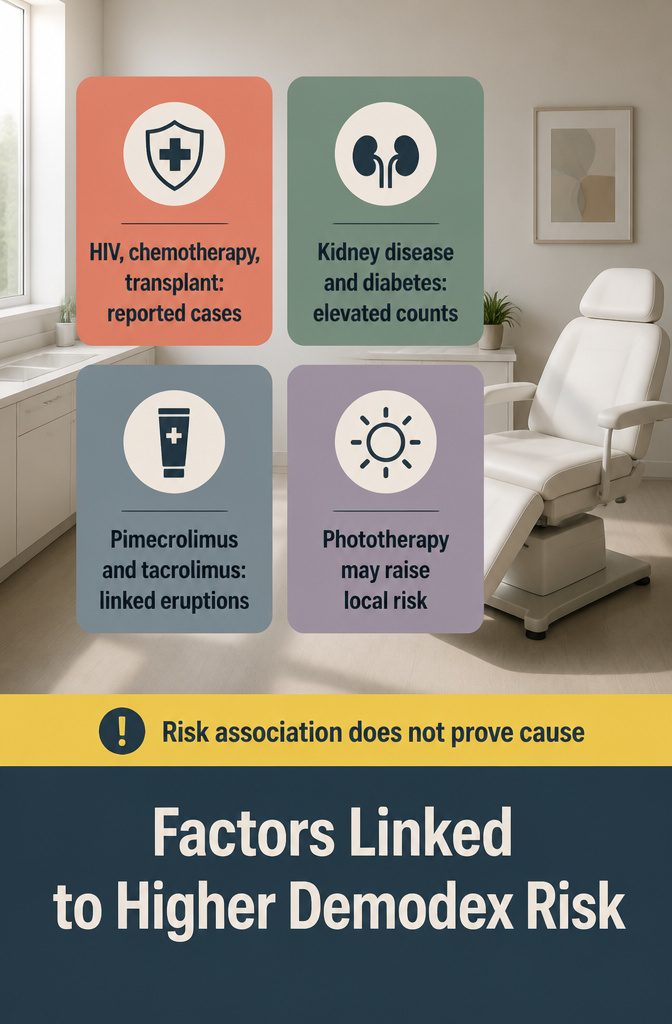
The association between weakened immune function and higher mite counts turns up in case after case, but it stops short of causation.
Patients with advanced HIV, those receiving chemotherapy for blood cancers, and individuals who have undergone stem cell transplants have presented with facial or scalp papules, pustules and itching that cleared when treatment targeted the mites.
Reports also describe elevated mite levels in people with end-stage renal disease and diabetes, conditions that bring less profound immune compromise.
Topical immunosuppressants add another layer. Pimecrolimus and tacrolimus, both calcineurin inhibitors applied to the face, have been followed by rosacea-like eruptions in which Demodex counts met the threshold for demodicosis.
Most resolved after stopping the cream and starting tetracycline antibiotics, though it remains unclear how much blame sits with local immune suppression, the underlying inflammation, or the mites themselves.
Phototherapy to the face, whether psoralen plus UVA or narrow-band UVB, may increase demodicosis risk through local immunosuppression and sebaceous gland enlargement.
What matters here is that these are risk associations. Finding mites on a scalp does not confirm they caused the eruption, especially when other factors are in play.
Reassess After Three Weeks if Oral Metronidazole Alone Does Not Improve Symptoms

If oral metronidazole for three weeks has not brought significant improvement, the treatment needs to change.
That timeline matters because proving demodicosis often relies on watching the response to anti-parasitic therapy, and three weeks is long enough to see whether the medication is working.
The usual next step is adding oral ivermectin at 200 micrograms per kilogram body weight, taken once, alongside one of the topical options. Some patients cannot tolerate metronidazone at all, and ivermectin becomes the oral choice from the start.
For patients whose symptoms do improve and then relapse, weekly intermittent permethrin 5% cream keeps mite levels down after the initial course finishes.
One case report described a patient whose rosacea-like demodicosis cleared with oral metronidazole and then stayed clear with permethrin applied once a week.
Daily Cleansing and Mild Shampoo as Part of Management

Daily cleansing matters, but it sits alongside prescription treatment rather than replacing it.
The approach I see repeated across clinical sources pairs washing hair and eyelashes daily with a mild shampoo with cleansing the face twice a day using a non-soap cleanser.
Regular washing reduces the oil that feeds mites and keeps dead skin from building up in follicles where they live.
These steps support medical therapy rather than stand alone. Sources that list daily shampooing and twice-daily face washing do so in the same breath as benzyl benzoate, permethrin, sulfur ointment and other acaricides aimed at bringing mite numbers down.
In severe cases, particularly when the immune system is compromised, oral ivermectin may be added. The routine hygiene buys you a cleaner surface, but the prescription work does the population control.
Frequently Asked Questions
What is Demodex folliculorum?
Demodex folliculorum is a microscopic mite 0.3–0.4 mm long that lives in the hair follicles of nearly every adult.
It feeds on sebum in the upper canal of the follicle and is harmless at low density, usually under 5 mites per square centimeter of skin.
The mite becomes a problem only when density climbs above that threshold alongside visible inflammation like redness, scaling, pustules, or hair loss.
What is the relationship between Demodex mites and seborrheic dermatitis?
Demodex mites can produce symptoms that overlap with seborrheic dermatitis, including scalp redness, scaling, and flaking, which is why diagnosis requires lab confirmation rather than visual inspection alone.
Elevated mite counts and inflammatory cells in multiple follicles distinguish demodicosis from seborrheic dermatitis, and anti-mite treatment clears cases where mites are the cause.
Many scalp conditions mimic each other, so a biopsy showing more than 5 mites per square centimeter plus compatible inflammation points toward demodicosis rather than another diagnosis.
Can you get rid of Demodex completely?
Demodex mites are normal residents of adult skin and cannot be eliminated completely, but treatment brings pathogenic populations down to low, harmless levels.
Metronidazole or ivermectin clears symptoms in confirmed cases, and weekly intermittent permethrin 5% cream after the initial course keeps mite density low and prevents relapse.
Treatment aims for control rather than eradication, since nearly every adult carries these mites without any problem.
Is it easy to get rid of mites?
Confirmed scalp demodicosis responds reliably to prescription treatment, with all 4 pathogenic scalp cases in one study clearing completely on metronidazole.
If 3 weeks of oral metronidazole does not bring improvement, adding oral ivermectin at 200 micrograms per kilogram body weight alongside a topical option typically works.
Daily cleansing with mild shampoo supports medical therapy but does not replace it, since prescription acaricides do the population control needed to resolve symptoms.